Table of Contents
- What Estate-Scale Planning Actually Requires
- Defensible Space Zones at Scale
- Fireproof Landscaping and Regional Plant Lists
- Privacy Hedges That Won't Feed a Fire
- Roads, Gates, Water, and Turnarounds
- Maintenance Calendar and Inspection Readiness
- On-Site Refuge Planning for Large Properties
- Frequently Asked Questions
- Key Takeaways
Most defensible space guides are written for a quarter-acre suburban lot. Owners of vineyards, ranches, and large rural estates are working with something categorically different: multiple outbuildings, long private driveways, gates that slow emergency vehicles, mature plantings that took decades to establish, and perimeter fencing that wasn't designed with fire in mind.
The fundamentals don't change at scale, but the execution does. A privacy hedge that's a tolerable risk on a city lot becomes a genuine ignition corridor when it runs 300 feet along a property line. Zone calculations that cover a typical house in under an hour can take days to assess across a large estate.
Evacuation remains the safest and most important action when fire threatens your property. This guide covers how to plan so that your property supports fast evacuation, gives firefighters a real chance to defend it, and reduces the conditions that cause a fire to accelerate toward your structures in the first place.
In Short
Large-property defensible space follows the same zone logic as any other parcel, but the planning scope, plant volumes, access infrastructure, and maintenance demands are categorically different. Getting it right means mapping your zones in detail, selecting ignition-resistant plants suited to your region, redesigning privacy screening that doesn't function as a fuel ladder, and confirming fire apparatus can actually reach your structures.
For vineyard, ranch, and estate owners who've invested in comprehensive wildfire preparedness, an on-site refuge option like the FORT™ is worth integrating into the plan from the beginning. Siting it properly on a large property is a specific consideration covered toward the end of this guide.
What Estate-Scale Planning Actually Requires
Large-property defensible space planning requires 3 formal deliverables that smaller properties rarely need: a site map, a roles assignment, and a scope document that defines what you're protecting and in what order.
Site Map
Your site map should identify every structure on the property, its distance from others, vegetation type and density, water sources, access roads and gates, and the slope and aspect of the land. Slope matters because fire travels faster uphill: a 10% slope roughly doubles fire spread rate, and a 30% slope can increase it by a factor of 4. If your main residence sits above a brushy canyon, that changes your zone calculations significantly.
Roles Assignment
On a property large enough that no single person can monitor everything, someone needs to own each of these functions before fire season starts:
- Monitoring: Watch Duty alerts, red flag warnings, local emergency notifications
- Access readiness: unlocked gates, clear turnarounds, road surface condition
- Vegetation maintenance: scheduling and sign-off
- Evacuation decision: authority and timing
On estate properties with household staff, those roles should be documented and rehearsed, not improvised.
Priority Ranking
You almost certainly can't protect everything equally. Occupied structures — the main residence, staff quarters, guest cottages — take priority over equipment storage, wine caves, or livestock barns. Your defensible space plan should reflect that hierarchy, with the most intensive treatment around structures where people sleep or shelter.
Defensible Space Zones at Scale
The zone framework applies to every structure on the property, not just the main house. That's the part most large-property owners get wrong.
California's standard framework defines 3 zones. Most other western states use comparable structures:
| Zone | Range | Goal |
|---|---|---|
| Zone 0 | 0–5 ft | Eliminate all combustibles from the immediate ember-landing area |
| Zone 1 | 5–30 ft | Manage, irrigate, and space plants to prevent fire travel from ground to structure |
| Zone 2 | 30–100 ft | Reduce fuel load and maintain spacing to slow fire approach |
Zone 0 (0–5 Feet)
Every secondary structure on the property has its own Zone 0. A guest cottage with a wood-framed trellis, a barn with hay stacked against the exterior, a workshop with wooden pallets stored under the eave — each one is an ignition point. Non-combustible gravel, decomposed granite, or concrete should cover the ground immediately adjacent to all foundations. Remove anything wood, fabric, foam, or organic within 5 feet of any exterior wall.
Zone 1 (5–30 Feet)
The most intensive management zone. The goal is to prevent fire from traveling plant to plant and from the ground up into the structure.
- No dead material or accumulated leaf litter
- Shrub canopies spaced at least 10 feet apart on flat ground, more on slopes
- No ladder fuels: ground cover connecting directly to mid-height shrubs connecting directly to tree canopies
- Trees limbed up to a minimum of 6 to 10 feet from the ground
- Irrigation maintained to keep moisture content high through fire season
On a large estate with a main residence, 2 guest cottages, a barn, a pool house, and a caretaker's unit, Zone 1 alone can represent several acres. Each structure requires its own 30-foot radius.
Zone 2 (30–100 Feet)
Zone 2 is about slowing fire approach, not eliminating vegetation. Trees spaced so canopies don't touch, ground cover kept low and green, dead material cleared regularly. For vineyards: irrigated cover crops between rows perform well in Zone 2, but dry grass between rows in fire season is a serious hazard. On slopes above 30%, extend Zone 2 beyond 100 feet — steep-slope fires move fast enough that the standard buffer may not provide adequate protection.
Fireproof Landscaping and Regional Plant Lists
No plant is fireproof. Fire-resistant means low oil content, high moisture content, minimal dead material accumulation, and no production of fine dry fuels. The right species depend entirely on your region.
Species to Avoid in Zones 0 and 1
| Plant | Problem |
|---|---|
| Lavender, rosemary | High volatile oil content; burns readily when dry |
| Juniper (all varieties) | Resinous, accumulates deadwood, burns intensely |
| Leyland cypress, arborvitae | Fast-growing fuel corridors; common hedge choices that carry high fire risk |
| Ornamental grasses | Produce large quantities of fine dry fuel by late summer |
| Eucalyptus | Oil content, bark shredding, and airborne ember production make it one of the most dangerous trees in wildfire conditions |
Species That Perform Well
| Plant | Notes |
|---|---|
| Ice plant, agave, aloe | High moisture content; ice plant requires dead patch removal |
| Toyon (Heteromeles arbutifolia) | California native; fire-resistant; can be maintained in hedge form |
| Indian hawthorn (Rhaphiolepis indica) | Lower-growing; suitable for Zone 1 screening |
| Native oaks (properly managed) | Open canopies and dense wood perform better than most people expect; requires limbing and leaf litter removal |
Regional Resources
Go to the source for your climate rather than relying on a single generic plant list:
- California coastal and inland valleys: UC Cooperative Extension fire-safe landscaping guidance and CAL FIRE's fire-resistant plant list
- Northern California foothills and Sierra Nevada: University of Nevada Cooperative Extension fire-resistant plant guide
- Texas Hill Country and Trans-Pecos: Texas A&M Forest Service wildfire mitigation resources (accounts for juniper/cedar encroachment specifically)
- Pacific Northwest: Washington State DNR Fire Adapted Washington program (fire behavior in Ponderosa pine and mixed conifer differs meaningfully from chaparral)
The consistent rule across all regions: irrigate and maintain through fire season. Zone 1 landscaping isn't a one-time installation.
Privacy Hedges That Won't Feed a Fire
Continuous perimeter hedges are among the highest fire-risk features on large rural properties, and they rarely get treated as a fire risk until it's too late. A 200-foot Leyland cypress hedge can function as a near-perfect fuel corridor once interior deadwood accumulates. The goal is privacy screening that doesn't behave like a fuse along your property line.
4 approaches work:
Non-Combustible Hardscape
Masonry walls, concrete block, or stucco-finish privacy walls provide genuine screening with zero fire risk. Expensive on long property lines, but worth serious consideration for sections closest to structures.
Segmented Plantings With Gaps
10 to 15-foot breaks between planted groupings prevent a single ignition from traveling the full length of the screen. A segmented planting of toyon or similar species still reads as a privacy screen from inside the property.
Ignition-Resistant Species
Toyon, Indian hawthorn, and some Pittosporum varieties perform substantially better than conifers. They won't give you a 15-foot solid screen, but pruned regularly they provide meaningful visual separation without the fuel load.
Living Screen With Masonry Backing
A 4 to 5-foot masonry wall with a managed planting on the interior side combines fire protection with privacy and works well for areas near structures.
Regardless of species, the pruning schedule matters as much as the planting decision. Hedges that accumulate years of interior deadwood become fire liabilities. Build the maintenance requirement into your annual calendar.
Roads, Gates, Water, and Turnarounds
Fire apparatus that can't reach your structures can't defend them. Access infrastructure is a fire safety issue, and it's consistently under-planned on large rural properties.
Road Standards
Most county fire departments and CAL FIRE publish apparatus access requirements for private roads. The consistent minimums:
- 12-foot clear travel lane (16 feet preferred)
- 15 feet of vertical clearance
- Turnouts every 400 feet on roads that can't accommodate two-way traffic
- A turnaround or hammerhead at the terminus sized for a fire engine
- Surface capable of supporting at least 40,000 pounds
If your ranch road softens when wet or washes out seasonally, solve that before fire season.
Gates
An electronic gate with a dead battery, or a combination lock your neighbors don't know, can delay apparatus access by critical minutes. Most fire agencies use the Knox Box rapid-entry system. Installing one so emergency responders have immediate keyed access is inexpensive relative to everything else involved in large-property fire preparedness.
Water Access
Large properties with ponds, pools, water tanks, or cisterns have a genuine advantage here. Map and label every water source so responding apparatus can find it quickly. A dry hydrant or drafting point at an accessible pond gives crews an independent supply that reduces dependence on truck capacity. Some rural fire agencies provide grants or cost-sharing for dry hydrant installation. A 4-inch connection on a pool or large tank costs relatively little to install and can be a meaningful resource for a responding crew.
Maintenance Calendar and Inspection Readiness
A well-designed defensible space plan that isn't maintained is worth nothing by August. Build a calendar, not a one-time project.
| Period | Tasks |
|---|---|
| February / March | Inspect all Zone 0 structures. Clean gutters and roof valleys. Confirm no combustible material against foundations. Verify gates and driveways are clear and functional. |
| April / May | Cut Zone 2 ground cover before it dries. Complete tree limbing. Clear dead material from Zone 1. Test irrigation serving Zones 0 and 1. |
| June – September | Monthly Zone 1 walk: remove accumulated dead material, check irrigation, watch for new dead trees. Keep driveways and turnarounds clear of encroaching vegetation. |
| October / November | Remove fallen leaves and branches from Zone 0. Assess underperforming plants; schedule spring replacements. Review evacuation plan and contact list. |
Insurance and Inspection Readiness
Many carriers now require a defensible space inspection before binding or renewing coverage on wildfire-exposed properties, and some use aerial imagery to verify conditions year-over-year. Document your maintenance work with dated photographs — it's straightforward and creates a record useful for both insurance purposes and future planning.
CAL FIRE's LE-100 inspection program applies to properties in State Responsibility Areas. The checklist is publicly available and a useful baseline for any large property in a high fire hazard severity zone, regardless of whether formal compliance is required.
On-Site Refuge Planning: The FORT™ for Large Properties
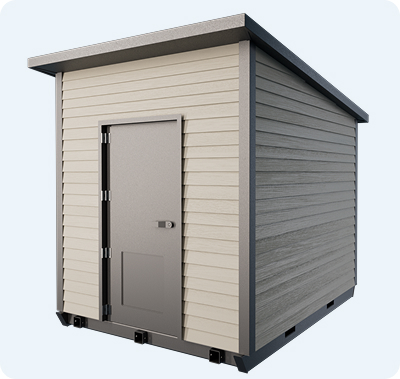 Large rural properties face a specific evacuation risk that suburban homeowners rarely encounter: a single road in and out. Canyon properties, ranch parcels on rural county roads, and vineyard estates on dead-end access routes can find evacuation compromised before fire is anywhere near the structures. That's the planning gap an on-site refuge addresses.
The FORT is a purpose-built above-ground refuge designed specifically for wildfire exposure. On a large property, where the investment already includes significant fire safety infrastructure, it fits naturally alongside defensible space, home hardening, and evacuation planning as part of a layered wildfire protection strategy.
Siting Considerations for Large Properties
Siting a refuge on a large property offers more flexibility than a suburban lot — and that flexibility is worth using deliberately:
- Proximity to the main residence: accessible within 2 to 3 minutes on foot from the primary occupied structure
- Fire approach direction: placed downslope or lateral to the most probable fire approach, not in its path
- Independent clearance zone: the FORT requires 30 feet of cleared, non-combustible perimeter with a bermed base — this should function independently of your Zone 1 plantings, not depend on them remaining intact
- Multi-structure properties: siting should reflect where staff or guests are most likely to be during a fire event, not just proximity to the main house
The FORT accommodates up to 8 people. For ranches or vineyards with seasonal staff, the emergency plan should specify who uses it, where it's located relative to work areas, and how it gets activated — before fire season, not during.
Learn About the FORT
Frequently Asked Questions
Key Takeaways
- Zone 0, 1, and 2 requirements apply to every occupied structure on the property, not just the main residence
- Slopes above 30% require extended buffers; the 100-foot Zone 2 standard was designed for average terrain
- Continuous conifer hedges (Leyland cypress, arborvitae, Italian cypress) are among the highest fire-risk features on large estate properties
- Gate access, road surface capacity, and turnaround clearance are fire safety requirements, not infrastructure afterthoughts
- Defensible space maintenance is seasonal and recurring; a plan that isn't maintained loses most of its value by August
- Vineyard row crops with irrigated ground cover perform well in Zone 2; dry grass between rows does not
- Large properties with single-road access face specific evacuation risk; an on-site refuge integrated into the broader plan addresses that gap directly
Final Thoughts
Estate, vineyard, and ranch owners face more complexity in wildfire preparedness than a typical homeowner, and they usually have more capacity to address it. The fundamentals of defensible space fireproof landscaping are consistent across property sizes. What changes at scale is the planning rigor, the maintenance commitment, and the number of structures and access points that need to be managed.
The goal of all of it is to evacuate early and safely, with a property prepared to give fire crews a real chance if they can reach it. Getting zones right, maintaining them through fire season, planting what actually performs under fire conditions, and making sure emergency access works are all part of that picture. For properties where a single road creates real evacuation uncertainty, an on-site refuge as part of a broader wildfire preparedness strategy is worth building into the plan from the start.