
Table of Contents
The phrase “fireproof document safe” sounds reassuring. It suggests certainty, that if your most important records are placed inside, they will survive whatever happens outside the box. For many homeowners and business operators, that belief becomes part of their preparedness planning. But in wildfire-prone regions, the reality is more complex. Most consumer document safes are engineered for short-duration residential fires under controlled laboratory conditions, not for prolonged radiant heat, structural collapse, or wildfire burnover exposure. Understanding that distinction does not mean document safes lack value; it means they need to be used within a broader wildfire protection strategy.
When properties are located in high-risk areas, especially estates, ranches, vineyards, and businesses with extensive physical archives, the difference between laboratory fire testing and real wildfire behavior becomes critical. This article explores what document safes are designed to protect, where their limitations begin, and how a layered approach that includes purpose-built solutions like FORT® can better align document protection with real-world wildfire conditions.
Summary
Fireproof document safes are designed to slow heat transfer during short-duration residential fires, but they are not built for prolonged wildfire exposure, structural collapse, or extended radiant heat. Understanding what these safes are tested for—and what they are not—is essential when planning for document protection in wildfire-prone areas.
A more reliable approach is layered protection. This includes storing critical records in multiple locations, maintaining secure digital backups, and preparing evacuation-ready copies of essential documents. These steps help ensure that important information remains accessible even if physical storage is compromised.
Within that broader strategy, some homeowners also consider additional on-site options. In rare situations when evacuation is not possible, a purpose-built refuge like FORT® can provide temporary protection for people and items brought inside—while still reinforcing that evacuation is always the first and safest choice.
What “Fireproof” Really Means
The word “fireproof” is often used casually, but in testing language it refers to a specific performance standard. Most document safes are rated to maintain an internal temperature below 350°F for a defined period, commonly 30 or 60 minutes. That threshold exists because paper begins to char and ignite at higher temperatures. The rating is based on a standardized furnace heat curve in controlled laboratory conditions, with a fixed exposure duration and stable positioning. It measures delay, not unlimited survival.
Most consumer safes rely on insulation materials that contain moisture. When exposed to heat, that moisture turns to steam and slows the rise of internal temperature. This mechanism is effective within its design window, but once that insulation is exhausted and exposure continues, internal temperatures can rise rapidly. A safe rated for one hour does not become a three-hour solution simply because it appears thick or heavy. The engineering goal is to buy time, not to endure indefinite fire exposure.
Why Wildfires Are Different
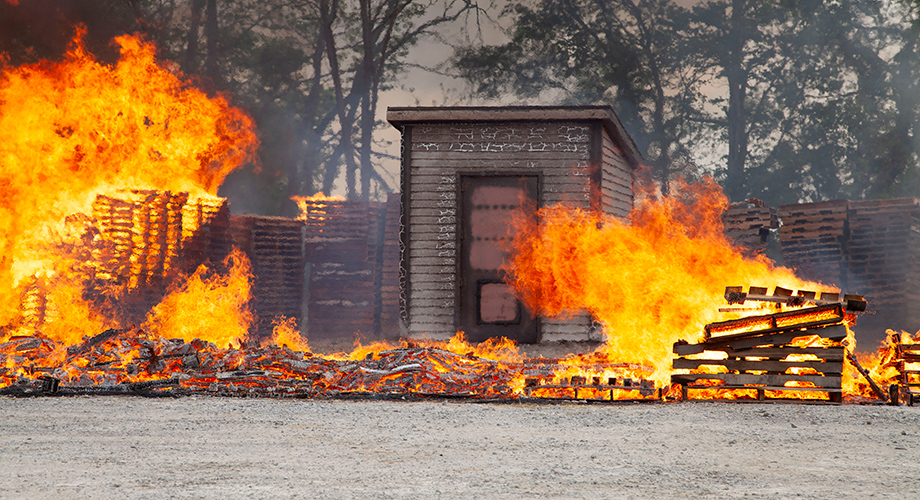
Residential structure fires and wildfires behave very differently. A typical house fire may burn intensely but often for a shorter duration within a contained environment. Wildfires, by contrast, expose structures to shifting wind patterns, repeated ember intrusion, radiant heat from nearby vegetation, and the possibility of structural collapse long after initial ignition. These conditions create longer and less predictable exposure profiles than standardized furnace testing.
- Sustained radiant heat from surrounding vegetation or nearby structures
- Repeated ember intrusion into vents, eaves, and rooflines
- Wind-driven flame fronts that change direction rapidly
- Multi-hour burn cycles when suppression response is delayed
- Structural collapse and debris accumulation that can smolder for extended periods
In these conditions, heat can radiate through walls and roofs can fail, leaving contents exposed to ongoing thermal stress. Some document safes do survive wildfires, but survivability depends heavily on exposure duration, debris load, and structural factors rather than on the category label of “fireproof.” Recognizing this difference allows property owners to plan based on realistic wildfire behavior instead of assuming laboratory testing translates directly to extreme wildfire events.
What UL Ratings Actually Test
Most document safes carry a UL Class 350 rating, which indicates that the interior temperature remained below 350°F during a standardized furnace test for a specified time period. These tests measure performance along a controlled time-temperature curve and may include limited cooling phases or drop tests intended to simulate structural collapse. They provide meaningful information about how a safe performs under defined conditions, but they do not replicate multi-hour burnovers or dynamic wildfire behavior.
Digital media introduces an additional vulnerability. USB drives, hard drives, and electronic storage devices can fail at internal temperatures between 125°F and 150°F. Most consumer document safes are not rated to protect digital media at those lower thresholds, which means important files may still be compromised even if paper survives. UL ratings are useful benchmarks and should be considered when purchasing a safe, but they should not be interpreted as wildfire vault certifications.
Why Fireproof Safes Fail in Wildfires
Water, Smoke, and Secondary Damage
Flame is only one part of the damage equation. In many fire events, documents that do not ignite are still compromised by water, steam, and smoke. Fire suppression efforts can saturate structures, burst plumbing can flood interiors, and steam generated from intense heat can penetrate insulation layers. Heavy soot can stain and chemically alter paper, making restoration difficult or impossible.
Even if a document safe prevents ignition, secondary damage can still compromise records, which is why redundancy matters. Physical storage should be paired with digital backups stored off-site or in secure cloud systems. Critical documents should exist in more than one format and location so recovery does not depend on a single container surviving a complex fire event. Layered planning reflects how damage actually occurs.
Fireproof Box vs. Larger Safe
Small fireproof boxes and larger document safes differ mainly in capacity and convenience rather than in core engineering. Smaller boxes are lightweight and portable, often rated for shorter durations, and commonly used for personal papers such as passports and certificates. Larger document safes are heavier, typically fixed in place, and may offer longer time ratings, making them suitable for offices or home studies with greater storage needs.
Both types share the same fundamental design philosophy: slow heat transfer for a defined period. Neither is engineered specifically for wildfire burnover conditions. Choosing between them should be based on daily access needs and storage volume rather than assumptions about survivability in extreme wildfire exposure.
Where Document Safes Still Make Sense
Despite their limitations, document safes remain useful when used appropriately. They provide meaningful protection in short-duration residential fires and offer an organized, secure location for critical originals. In many regions, they significantly reduce risk and support smoother recovery from localized incidents. When paired with digital backups stored securely off-site, they form a strong first layer of protection.
- Birth certificates and passports
- Deeds, titles, and property documentation
- Estate planning records
- Insurance paperwork
- Sensitive personal identification documents
The key is recognizing that a document safe is one component within a broader preparedness framework rather than a standalone wildfire solution. In higher-risk areas, it should sit alongside digital redundancy and evacuation planning so you are not relying on a single container during a complex fire event.
The Evacuation Reality
Wildfire preparedness ultimately intersects with evacuation logistics. When threat levels rise, time becomes limited and priorities narrow quickly. Family members, pets, medications, and essential items come first. Vehicle space is finite, and attempting to transport an entire archive of physical documentation can delay departure at a critical moment.
For estate owners, agricultural operations, and business managers, the challenge is amplified. Multiple filing cabinets, compliance binders, financial records, and operational documents may represent decades of accumulated work. While some materials can be digitized, many industries still require physical retention of original records. You cannot realistically load entire cabinets into a vehicle under time pressure, and you should never compromise life safety attempting to do so.
Portable evacuation binders containing essential copies should be staged near exit paths. Bulk documentation, however, requires a more deliberate solution.
Using FORT® to Protect Documents
FORT® can support document protection as part of a layered wildfire preparedness strategy.
FORT® was developed as a purpose-built wildfire refuge integrated into comprehensive preparedness planning. While its primary role is life safety, its engineering also allows it to serve as a hardened storage space during periods of elevated wildfire threat.
Unlike consumer document safes, FORT® is designed to withstand extreme wildfire exposure conditions.
When wildfire risk increases but before evacuation orders are issued, property owners can temporarily relocate bulk documentation into the unit. This may include entire file drawers, historical property records, compliance documentation, financial archives, and secure digital storage devices.
Rather than forcing a choice between taking everything or leaving everything, owners can evacuate people and essential materials while staging bulk records inside a structure designed for wildfire exposure.
This approach does not replace document safes. It strengthens the overall plan. In a layered wildfire protection strategy, document safes handle everyday storage, evacuation binders support rapid departure, and FORT® provides hardened protection for both people and high-value materials when threat levels rise.
Each layer has a specific function, and together they create resilience aligned with real wildfire conditions.
FAQs
Key Takeaways
- Fireproof document safes provide time-limited resistance under controlled conditions, not guaranteed survival in wildfire burnovers.
- UL ratings measure delay, not indefinite protection.
- Water and smoke can cause significant secondary damage, even when documents do not ignite.
- Digital backups reduce dependence on any single container and strengthen recovery planning.
- Integrating document safes, evacuation staging, and a purpose-built refuge like FORT® within a comprehensive preparedness strategy aligns protection with real wildfire behavior.
Final Thoughts
Fireproof document safes are often misunderstood. They are engineered to slow heat transfer during limited-duration structural fires, not to withstand prolonged wildfire burnovers. In wildfire-prone regions, stronger protection comes from layered planning grounded in realistic exposure conditions.
Everyday document safes, digital redundancy, evacuation readiness, and purpose-built solutions like FORT® can work together to protect both people and the records that sustain households, estates, and businesses. Resilience is built by understanding what each layer is designed to do and integrating them thoughtfully into a comprehensive wildfire preparedness strategy.