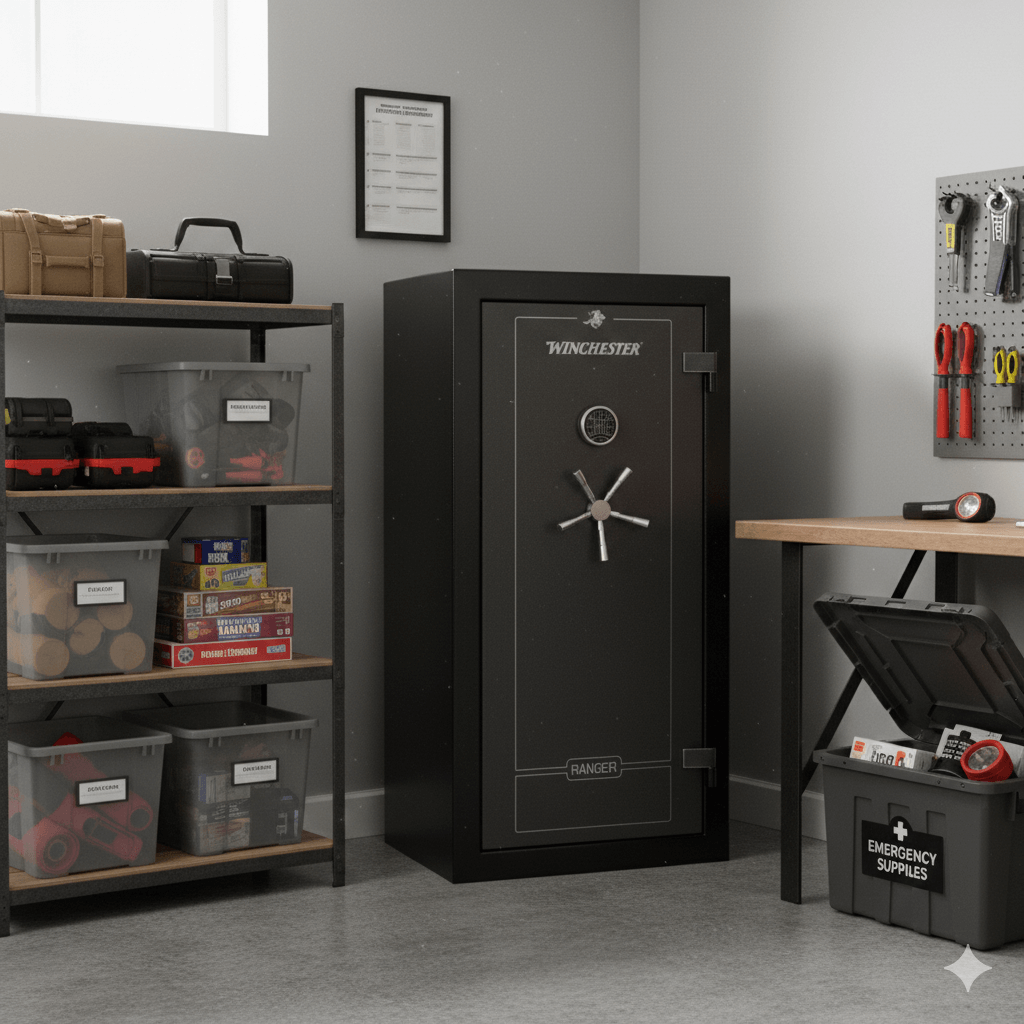
A fireproof gun safe is engineered first and foremost as a security device. Its primary purpose is theft deterrence, controlled access, and responsible storage, with fire resistance typically added as a secondary feature. Most residential safes earn fire ratings through short-duration, controlled exposure testing in laboratory settings. Structural wildfire exposure is a different risk category, shaped by prolonged radiant heat, ember intrusion, heavy suppression water, shifting fuel loads, and the possibility of structural collapse.
In wildfire-prone regions, understanding design intent prevents false confidence. A gun safe may reduce damage in certain limited fire scenarios, but it is not engineered for sustained structural wildfire conditions. Treating it as wildfire protection infrastructure can lead to planning gaps, especially around evacuation readiness and asset prioritization. This buyer’s guide explains what safe ratings actually mean, how to choose and place a safe responsibly, and how secure storage fits into a broader, infrastructure-focused wildfire strategy.
In Short
Fireproof gun safes are primarily theft-deterrent devices. Their fire ratings reflect controlled, limited-duration exposure under standardized laboratory testing, not sustained structural wildfire events. They can improve day-to-day security and reduce risk in defined scenarios, but they are not engineered for prolonged radiant heat, collapse, or heavy suppression water exposure. A realistic wildfire plan treats secure storage as one component of preparedness, not a substitute for broader resilience measures.
Table of Contents
- Fire & Burglary Ratings
- Capacity & Configuration
- Placement & Environment
- Fireproof & Waterproof Claims
- What to Avoid
- Choosing a Safe
- Compliance & Access
- Related Storage
- The Role of FORT® in Wildfire Planning
- Key Takeaways
- FAQs
- Closing Thoughts
Fire & Burglary Ratings
Gun safes are built around two separate performance goals: resisting forced entry and slowing heat transfer during controlled fire exposure. Burglary resistance is influenced by steel thickness, door and frame reinforcement, internal bolt work, relocking mechanisms, and lock reliability. Fire resistance is measured by how long the safe’s interior stays below a specified temperature threshold during standardized testing. These categories address different threats, so buyers should evaluate them independently rather than assuming one implies the other.
Fire ratings are determined under laboratory protocols that control time, temperature, and setup conditions. Wildfires can introduce prolonged radiant heat, debris loading, structural collapse, and heavy suppression water, which exceed most residential testing assumptions. A fireproof gun safe should therefore be evaluated primarily as a theft-deterrent device with limited fire resistance, not as structural wildfire protection. The most responsible approach is to use ratings for comparison and expectation-setting, not as a promise of preservation in extreme events.
- Steel gauge of body and door
- Reinforced locking bolts and relockers
- Mechanical, electronic, or biometric lock systems
- Fire rating duration and maximum temperature
- Insulation materials and intumescent door seals
Exposure scenarios that exceed laboratory testing assumptions require different categories of protection than most residential storage products are designed to provide.
Capacity & Configuration
Advertised capacity often reflects tightly packed theoretical storage rather than realistic use. Many “gun count” claims assume similar firearm sizes, minimal spacing, and no accessories, which is rarely how safes are used in practice. Optics, grips, lights, and rails reduce usable space and can force awkward stacking that increases handling risk. Buyers planning long-term ownership should assume realistic capacity will be lower than marketing figures suggest, especially for long guns with mounted optics.
Interior configuration affects workflow and safety more than any exposure outcome. Adjustable shelving, barrel supports, and door organizers can improve access control, reduce clutter, and prevent unnecessary handling. Larger safes provide convenience and expansion flexibility, but size does not meaningfully change performance in sustained structural wildfire conditions. Capacity decisions should be made for organization and day-to-day functionality, not for an assumed increase in wildfire survivability.
Placement & Environment
Safe placement influences theft resistance, stability, and long-term maintenance. Anchoring to a concrete slab helps prevent removal during burglary attempts and improves stability over time. Raised foundations may require structural evaluation, and upstairs placement should account for floor load limits and installation logistics. Garages can carry higher fuel exposure due to stored vehicles, tools, and combustible materials, so placement should be chosen deliberately rather than by convenience alone.
Environmental management protects firearms and optics across seasons. Humidity swings can cause corrosion, particularly in coastal areas and basements, and temperature variability can degrade sensitive components over time. These measures improve day-to-day performance but do not convert a residential gun safe into a wildfire-rated vault. The goal is to maximize security and preservation under normal conditions while maintaining realistic expectations under extreme wildfire exposure.
- Anchor securely to structural concrete when possible
- Avoid flood-prone areas and known water intrusion zones
- Use dehumidifier rods or desiccants for corrosion control
- Inspect seals, locks, and interior condition on a set schedule
Fireproof & Waterproof Claims
“Fireproof” and “waterproof” are often used broadly in marketing, but their technical meaning is more limited. Fire resistance depends on insulation designed to slow heat transfer for a defined duration under controlled test conditions. Intumescent door seals expand during heat exposure to restrict airflow and slow temperature rise, but structural deformation and prolonged exposure can still compromise integrity. Ratings operate within specific laboratory parameters and should be interpreted as benchmarks, not guarantees.
Water resistance often refers to short-term exposure tolerance rather than prolonged immersion or collapse-related saturation. During wildfires, heavy suppression water, damaged plumbing, and extended humidity are common, and moisture intrusion can damage optics, electronics, and documents even when heat exposure is partially reduced. Suppression water, prolonged radiant heat, and structural failure can still compromise contents under extreme conditions. For wildfire planning, the safe’s value is in security and limited fire resistance under defined scenarios, not reliable preservation under severe wildfire exposure.
What to Avoid
Marketing language can imply total protection where performance is defined and limited. Undefined “fireproof” claims without stated duration and temperature thresholds are not meaningful for comparison. Thin-gauge steel may look substantial but offer limited burglary resistance, and inflated capacity claims often ignore optics and realistic spacing. Buyers in wildfire-prone areas benefit from prioritizing documented specifications and build quality over broad assurances.
Realistic expectations are essential, especially when fire risk is part of the decision. A gun safe is a security device with defined limits, not wildfire survival infrastructure. When buyers treat a safe as “one layer” rather than “the plan,” the rest of the preparedness system stays stronger. Look for transparency, independent testing references when available, and construction details that support theft deterrence as the primary objective.
- “Fireproof” without documented rating criteria
- Minimal steel thickness or unclear construction specs
- No independent testing reference or traceable standard
- Overstated firearm capacity that ignores optics and spacing
- Basic drywall-only insulation framed as comprehensive protection
Choosing a Safe
Selecting a safe begins with clarifying purpose. For most buyers, the primary objective is theft deterrence and responsible storage compliance, with fire resistance treated as a secondary consideration. Fire ratings should be evaluated as controlled exposure benchmarks for comparison, not as wildfire guarantees. Steel thickness, lock reliability, bolt work, and installation logistics generally matter more over the life of the safe than feature lists or marketing language.
A structured approach keeps choices realistic and repeatable. A gun safe should be evaluated primarily as a security device, and wildfire risk planning should be addressed through additional, separate measures. If wildfire exposure is a primary concern, additional planning layers beyond consumer safes may be appropriate. A FORT®, for example, is designed to withstand structural wildfire conditions as well as sustained burnover exposure.
Buyers of traditiinal consumer safes also benefit from budgeting for proper installation, anchoring, and humidity control rather than spending entirely on cosmetic upgrades. When the safe’s role is clearly defined, it becomes easier to build the rest of a wildfire plan without overreliance on residential storage products.
- Define the primary goal: theft deterrence vs. limited fire exposure
- Verify fire rating duration and stated test conditions
- Evaluate lock reliability and backup access method
- Plan placement, anchoring, and load considerations
- Establish a humidity control and maintenance routine
Compliance & Access
Safe storage laws vary by jurisdiction and generally focus on preventing unauthorized access, especially by minors. Lock choice should account for reliability over time and performance during power interruptions. Mechanical locks avoid battery dependency, while electronic and biometric options can offer faster access but require maintenance and periodic testing. Backup access procedures should be documented and practiced so the safe remains usable and secure over the long term.
Access under stress is a practical consideration that matters in real-world scenarios. During wildfire warnings, clarity and speed are critical, and secure storage planning should never delay evacuation decisions. Asset protection tasks should be planned ahead of time and kept separate from life-safety actions. A safe supports responsible ownership and compliance, but it should not introduce friction into evacuation readiness.
Related Storage
Many households supplement firearm storage with separate fire-rated safes for documents, artwork, and valuables. These products are also tested under controlled conditions and have defined limits under extreme wildfire exposure. Paper, digital media, and heirlooms often have lower tolerance thresholds for heat and moisture than many people assume. Treating any consumer storage product as a guarantee of preservation can create avoidable risk.
Residential storage devices can reduce loss within tested parameters, but they do not reliably preserve contents during severe structural wildfire scenarios. The most useful mindset is to treat storage as a tool for organization, access, and limited risk reduction, while planning separately for wildfire exposure conditions that exceed residential testing. This approach supports clearer priorities, earlier decisions, and fewer assumptions during high-stress periods. It also aligns with long-term resilience planning for properties in fire-prone regions.
For properties facing recurring wildfire exposure risk, some owners incorporate engineered refuge or protection systems designed for sustained structural fire conditions as part of long-term resilience planning.
Learn more about why most fireproof safes fail
The Role of FORT® in Wildfire Planning
Gun safes are engineered for theft deterrence and limited, laboratory-tested fire exposure. They are not designed for sustained structural wildfire conditions, prolonged radiant heat, debris loading, structural collapse, or internal ignition caused by extreme temperatures.
In severe wildfires, temperatures can rise high enough to ignite stored ammunition. When that occurs, ammunition may rupture or explode, and unsecured firearms exposed to direct flame or extreme heat may discharge. Residential gun safes are not engineered to contain or manage that type of exposure.
For property owners who wish to protect firearms and other sensitive assets from structural wildfire conditions, planning must extend beyond consumer storage products.
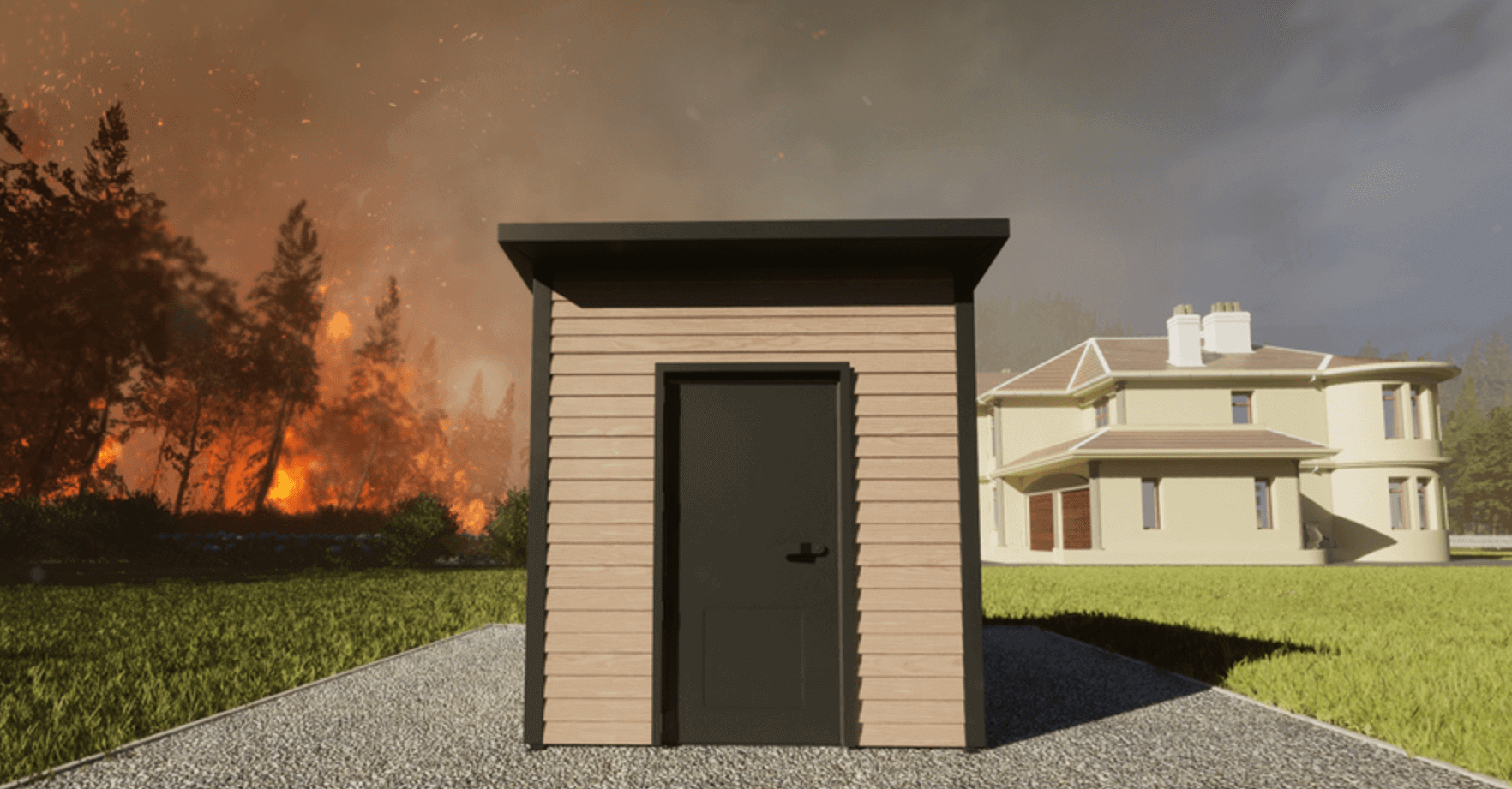
A FORT® is engineered as part of a comprehensive wildfire protection strategy. Unlike residential gun safes, it is built using mining-grade refuge chamber technology adapted specifically for wildfire exposure. It has been tested under structural fire standards such as ASTM E119 and CAN/ULC S101 and is designed to withstand sustained burnover conditions while maintaining controlled internal environments.
Within an integrated wildfire plan, firearms and other irreplaceable assets can be intentionally placed inside a FORT® in advance of escalating conditions. Because the FORT® is engineered for prolonged wildfire exposure rather than short-duration laboratory testing, it serves a fundamentally different role than a residential gun safe.
A FORT® is not a substitute for defensible space, home hardening, or evacuation planning. It is an engineered protection layer designed to function within a broader wildfire resilience strategy, addressing exposure scenarios that exceed the design limits of consumer safes.
Discover the FORT®.
Key Takeaways
Fireproof gun safes can be a smart security investment, but only when they’re evaluated realistically and used within a broader preparedness plan. The most resilient strategies are built on clear roles, documented limits, and proactive decisions made well before conditions escalate.
- Fireproof gun safes are primarily theft-deterrent devices; fire ratings reflect controlled, limited exposure.
- Wildfires introduce prolonged heat, collapse, embers, and suppression water that exceed most residential safe testing conditions.
- Capacity claims are often inflated; plan for optics, accessories, and safe spacing.
- Placement, anchoring, and humidity control improve day-to-day performance, not wildfire survivability.
- “Fireproof” and “waterproof” labels should be treated as benchmarks, not guarantees.
- Evacuation planning should never be delayed by asset protection tasks or safe-access steps.
- Engineered protection systems like FORT® serve a different role than consumer safes and should be integrated thoughtfully.
FAQs
Are fireproof gun safes designed to survive wildfires?
No. Fireproof gun safes are designed primarily for theft deterrence and limited fire exposure under controlled laboratory conditions. Structural wildfires involve prolonged radiant heat, structural collapse, ember intrusion, and heavy suppression water that exceed most residential safe testing standards. While a safe may reduce damage in certain contained fire scenarios, it is not engineered for sustained wildfire burnover conditions. Treating it as wildfire protection infrastructure can create unrealistic expectations about performance during extreme events. In wildfire-prone regions, owners concerned about preserving firearms or sensitive assets during severe structural fire exposure should evaluate engineered protection systems designed specifically for wildfire conditions.
What does a gun safe fire rating actually mean?
A fire rating reflects how long the interior of a safe remains below a specific temperature during standardized laboratory testing. The rating is based on controlled time-and-temperature exposure and does not replicate real-world wildfire dynamics. Wildfires introduce variables such as structural collapse, debris loading, and prolonged radiant heat that are not part of most residential safe tests. Fire ratings are useful for product comparison, but they should not be interpreted as guarantees during severe wildfire exposure.
Are waterproof gun safes fully waterproof after a fire?
Most residential safes marketed as “waterproof” are designed to resist short-duration exposure under specific conditions. They are not engineered for prolonged immersion, structural collapse, or extended post-fire humidity. During wildfire events, heavy suppression water and damaged plumbing can introduce significant moisture exposure. Electronics, optics, and paper materials remain vulnerable even if heat exposure is partially mitigated. Water resistance should therefore be viewed as limited protection rather than complete moisture immunity.
Should a gun safe influence evacuation decisions during a wildfire?
No. Secure storage planning should never delay or complicate evacuation decisions. Wildfire preparedness prioritizes early evacuation and adherence to official guidance. Asset protection strategies should be established in advance and remain separate from life-safety execution. In dynamic wildfire conditions, clarity and speed are critical, and evacuation planning must remain the primary priority.
Where does secure storage fit within a wildfire resilience strategy?
Gun safes address theft deterrence and limited fire exposure under defined laboratory conditions. Wildfire resilience requires broader measures, including defensible space, home hardening, evacuation readiness, and engineered protection systems designed for specific exposure categories. Secure storage plays an important role in everyday risk management, but it does not replace structural wildfire planning. Effective resilience strategies clearly define the purpose and limits of each protective layer.
Closing Thoughts
A fireproof gun safe is a security device with defined limits. It is designed primarily for theft deterrence and rated for controlled, limited fire exposure under laboratory conditions. It is not engineered for sustained structural wildfire exposure, and treating it as such can create planning gaps when conditions escalate. Clear expectations help owners choose wisely, install responsibly, and avoid overreliance on residential storage products.
Responsible wildfire planning is layered and intentional. Secure storage, home hardening, defensible space, and evacuation readiness each serve distinct roles, while engineered protection systems address different exposure categories than consumer products. For homeowners and estate teams, the strongest plans are built early, maintained routinely, and grounded in realistic performance limits. When each component is used for what it’s designed to do, the overall system becomes more resilient over time.
-1.jpg)