Table of Contents
- What Is a Fireproof Safe Room?
- Storm Shelters, Security Rooms, and Wildfire: Not the Same Problem
- Heat and Smoke Pathways: Why Ratings Have Real Limits
- Materials and Construction: What Actually Matters
- Siting and Egress: Placement Decisions That Affect Survival
- Training and Drills: How a Safe Room Fits Your Evacuation Plan
- The FORT: A Purpose-Built Wildfire Refuge
- Frequently Asked Questions
- Key Takeaways
The phrase "fireproof safe room" gets used loosely. You'll see it in home listings, in contractor ads, and scattered across preparedness forums — usually without much explanation of what it actually means. For homeowners in high-risk wildfire zones, that vagueness can create a false sense of security that's genuinely dangerous.
A safe room can be a smart part of a home protection strategy. But the category covers a lot of ground — storm shelters, security panic rooms, and above-ground fire refuges are all sometimes marketed under the same umbrella term. Each is designed for a specific threat. The engineering, the ratings, and the real-world performance differ significantly. This guide breaks down what residential safe rooms are built to handle, where the limits are, and how construction and placement decisions shape what you can actually count on when a wildfire is moving toward your property.
Evacuation is always the priority. Getting out early, before roads are compromised and conditions deteriorate, is the most reliable way to protect your family. A safe room — whether integrated into your home or installed as a standalone structure — is a planning layer for situations when evacuation isn't possible, not an alternative to it.
In Short
A fireproof safe room is a reinforced space designed to provide protection during a hazardous event. Most products marketed as safe rooms are engineered for wind, debris, or intruder threats — not wildfire-specific conditions like radiant heat, ember intrusion, or sustained high-temperature exposure. The ratings and materials that matter for one threat type often don't translate directly to another.
For homeowners planning around wildfire risk, the key is understanding what your safe room was actually designed to do — and where purpose-built options like the FORT® provide capabilities that conventional safe rooms don't. A layered wildfire protection plan accounts for these differences.
What Is a Fireproof Safe Room?
The term "fireproof safe room" doesn't have a single regulated definition. In common use, it refers to a hardened room or structure designed to protect occupants from a dangerous event — fire, extreme weather, or a security threat. The "fireproof" qualifier usually refers to the fire rating of the construction materials: walls, doors, and assemblies tested to resist heat for a specified duration under controlled laboratory conditions.
Fire ratings are real and meaningful. A 90-minute fire door performs very differently from a standard interior door in a structure fire. But fire ratings for building materials are developed primarily with structure fires in mind — a contained, relatively predictable event measured under standard test conditions. A wildfire burnover is a different animal. It involves radiant heat at much greater distances, sustained high temperatures, airborne embers traveling ahead of the flame front, and rapid atmospheric changes that no single door or wall assembly was designed to manage on its own.
So when a contractor says a room is "fireproof," the honest follow-up question is: fireproof for what? That distinction matters enormously in wildfire planning.
Storm Shelters, Security Rooms, and Wildfire: Not the Same Problem
Walk into any home improvement trade show and you'll find safe rooms marketed for tornadoes, hurricanes, home invasions, and wildfires — sometimes all at once. The marketing often implies interchangeability. The engineering doesn't support it.
Storm Shelters
FEMA-rated storm shelters are designed to protect against high-velocity wind and airborne debris. The relevant standard is ICC 500, which covers impact resistance, structural loads, and pressure differentials from tornadic conditions. These shelters are built to keep flying debris out. They're typically steel or reinforced concrete, with impact-rated doors.
What they're not designed for: managing radiant heat from an external fire source, maintaining breathable air during combustion, or sealing against smoke infiltration. A storm shelter may survive a wildfire structurally — but occupants inside can face dangerous smoke concentrations and heat long before the structure itself is compromised.
Security Safe Rooms / Panic Rooms
Security safe rooms are built for human threat scenarios — forced entry, home invasion, civil unrest. They prioritize structural reinforcement against mechanical force: thick walls, reinforced door frames, steel doors with multi-point locks. Some include ballistic-rated materials.
Heat resistance and smoke sealing aren't design criteria for security rooms. A walk-in safe room that stops a battering ram won't necessarily do anything useful against a wildfire burning through adjacent rooms.
Wildfire-Specific Requirements
A room designed to protect against wildfire needs to address 4 specific physical threats that the other categories largely ignore:
- Radiant heat penetrating through walls and doors before direct flame contact
- Convective heat from superheated air moving through gaps, vents, and imperfect seals
- Smoke and toxic combustion gases infiltrating through any unsealed opening
- Oxygen depletion as surrounding combustion consumes available air
A room that addresses all 4 of these requires different engineering than a storm shelter or a panic room. The construction decisions — materials, seals, air supply, door assembly — need to be made with wildfire behavior in mind.
Heat and Smoke Pathways: Why Ratings Have Real Limits
The most common misunderstanding about fire-rated construction is the assumption that a rated wall or door creates a complete barrier. It doesn't. Fire ratings measure how long a tested assembly resists flame penetration under specific laboratory conditions. They say nothing about smoke, and they're measured in isolation — not as part of a system.
The Smoke Problem
Smoke moves through gaps too small to see. A fire-rated door installed in a standard frame with no intumescent seals will allow smoke infiltration long before heat becomes a structural issue. During a wildfire, toxic smoke is a serious threat — carbon monoxide, hydrogen cyanide, and particulate matter from burning vegetation and synthetic materials can incapacitate occupants in minutes.
Sealing a safe room against smoke requires specific detailing at every penetration: door frames, electrical boxes, plumbing, HVAC connections, and any gap in the wall or ceiling assembly. This isn't standard in most home construction — it has to be specified and verified.
Radiant Heat
Radiant heat doesn't require flame contact to cause injury. It travels in straight lines and can cause burns through walls and windows before direct fire reaches a structure. This is why ember intrusion and radiant heat are responsible for most residential wildfire losses — not the advancing flame front itself.
Concrete and masonry perform well as thermal mass against radiant heat. Standard wood-framed walls with gypsum board are rated for fire resistance time, but their thermal mass is limited. In a prolonged burnover, interior temperatures in a wood-framed "safe room" can rise significantly even without direct flame contact.
Air Supply
This is the variable that most residential safe room discussions skip entirely. A sealed room with no independent air supply is safe from smoke only as long as its seal holds — and only as long as the occupants don't deplete the oxygen inside. For a short-duration event, this may be acceptable. For a wildfire burnover that could last 30 minutes to several hours, the math gets uncomfortable quickly.
A room that provides genuine protection for extended wildfire exposure needs either a managed fresh air supply or a stored breathing air system. This is standard engineering in industrial refuge chambers and mining shelters, but it's rarely addressed in residential safe room products.
Materials and Construction: What Actually Matters
If you're evaluating a safe room for wildfire use — or having one built — these are the construction elements that have real bearing on performance:
Wall Assembly
Concrete and masonry provide the best combination of structural resistance and thermal mass. Insulated concrete forms (ICF) or precast concrete panels are commonly used in purpose-built fire shelters. A wood-framed room with Type X gypsum offers some fire resistance, but its performance in a wildfire is materially different from a concrete structure.
Door Assembly
A fire-rated door is a meaningful upgrade, but the door alone isn't the system. The frame, the threshold, and the seals all need to work together. An intumescent seal that expands under heat to close gaps is an important component. The door hardware — handles, hinges, latching mechanism — should be rated for the same conditions as the door itself.
Seals and Penetrations
Every gap in the building envelope is a smoke pathway. Electrical conduit, plumbing, HVAC ductwork, and even small cracks in framing need to be sealed with fire-rated caulk or intumescent products. In practice, this level of detailing requires a contractor who understands the goal and inspects the work carefully.
Ventilation and Air
Any room with active ventilation connected to the home's HVAC system has a direct smoke infiltration pathway during a wildfire. That connection either needs to be sealed before occupancy or equipped with a smoke-rated damper. A standalone air supply system — compressed breathing air or filtered positive-pressure ventilation — provides an additional layer of protection for longer-duration events.
Siting and Egress: Placement Decisions That Affect Survival
Where a safe room sits within your home, and how you exit it after a fire, are planning questions that get less attention than they deserve.
Location Within the Home
A safe room on the side of the house facing the primary fire approach direction will experience more radiant heat loading than one on the opposite side. Interior rooms without exterior walls have less direct heat exposure. A below-grade or partially below-grade room has thermal advantages but introduces drainage and egress complications that need to be addressed in the design.
On-site clearance matters too. A room installed in a home surrounded by dense vegetation has a fundamentally different risk profile than the same room in a home with well-maintained defensible space. The safe room doesn't operate in isolation — its performance depends on the broader environment around it.
Rescue Visibility and Emergency Access
First responders need to be able to find and reach you after a fire. If your safe room has no exterior visibility, no secondary exit, and no way to signal your location, you may be safe inside and still face serious difficulty getting out. Some purpose-built fire shelters include external communication and signaling systems for exactly this reason.
Egress After the Event
A burnover can change the external environment significantly. Doorways may be blocked by debris. Structural elements of the home may be compromised. A safe room should have a clear plan for how occupants exit when the fire passes — not just how they enter when it arrives. Secondary egress options, whether a secondary door, a hatch, or a designated escape route, should be part of the design from the start.
Training and Drills: How a Safe Room Fits Your Evacuation Plan
A safe room is a planning tool. Its value depends entirely on how well your household knows how to use it — and how clearly it fits within a broader evacuation strategy.
The most important thing to be clear about first: a safe room is not an excuse to delay evacuation. Leaving early, before official orders if possible, is the decision that gives your family the most options. A safe room is for situations when evacuation has failed or become impossible — roads cut off, fire advancing faster than expected, a family member unable to move quickly.
What a Drill Should Cover
At minimum, every person in your household should know:
- Where the safe room is and how to reach it quickly from any part of the house
- How to seal the door and where the sealing materials are stored
- What supplies are inside and how to access them
- How to communicate from inside the room (cell signal, satellite device)
- How to check conditions and determine when it's safe to exit
- The exit plan — both primary and secondary
Running a timed drill twice a year, ideally timed around your fire season, reveals gaps you won't see on paper. Can elderly family members reach the room in time? Is the path clear? Do children know what to do without adult guidance? These are the questions a drill answers.
Integration with Your Emergency Plan
A safe room should be one element in a documented family emergency plan that also covers evacuation routes, communication protocols, go-bag contents, and check-in procedures. The plan should be reviewed and refreshed at least annually — and the safe room inspection should be part of that review.
The FORT: A Purpose-Built Wildfire Refuge
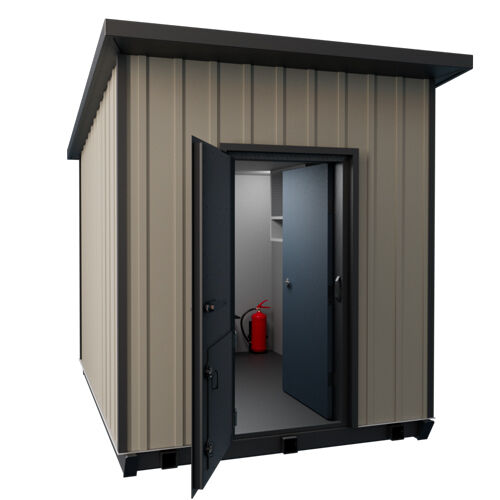 Most residential safe rooms are adapted from designs built for other threats. The FORT was designed from the ground up for wildfire — which produces a meaningfully different product.
The FORT is an above-ground, standalone refuge structure built with EVG-3D modular panels coated with flame-resistant precast concrete. Its construction provides genuine thermal mass against radiant heat. The doors — an outer door designed for high-temperature burnover and a specially engineered inner fire door with a fire-resistant handle and secure seal — work together as a system, not as independent components.
Where the FORT differs most from a conventional safe room is in its life-safety systems. The unit includes a managed breathing air system with compressed air cylinders that maintain oxygen concentration and carbon dioxide levels within safe ranges for up to 4 hours — based on standards drawn from NIOSH studies and CFR 30 Part 7 mine refuge chamber regulations. Fresh breathable air at positive pressure means smoke infiltration is addressed at the system level, not by hoping the seals hold.
The FORT also includes communications equipment, emergency supplies, and monitoring capabilities. When the doors are opened and the unit is activated, Wildfire Safety Systems' monitoring center is notified. A Personal Locator Beacon option provides GPS-based emergency signaling.
For homeowners evaluating on-site refuge options, the FORT represents what happens when wildfire-specific engineering is applied from the design stage — not retrofitted onto a product built for a different threat. It fits within a comprehensive wildfire safety strategy alongside defensible space, home hardening, and evacuation planning.
Learn About the FORT
Frequently Asked Questions
Key Takeaways
- "Fireproof safe room" covers a wide range of products — storm shelters, security rooms, and fire refuges are built for different threats and perform very differently in wildfire conditions
- Fire ratings measure flame resistance under lab conditions, not smoke infiltration, radiant heat, or air supply — all of which matter in a wildfire
- A safe room without a sealed envelope and a managed air supply may not protect occupants from smoke and oxygen depletion during a sustained burnover
- Concrete and masonry provide significantly better thermal performance than wood-framed construction with gypsum board
- Siting, egress planning, and emergency signaling are as important as the room's construction materials
- Regular drills are what convert a safe room from a physical asset into a functioning safety plan
- Purpose-built wildfire refuges address heat, smoke, and air supply as an integrated engineering system — not as separate construction choices
Final Thoughts
A fireproof safe room is a real concept with real value — but only when the engineering matches the threat it's meant to address. The problem isn't that safe rooms don't work. It's that the category is broad enough to include products designed for entirely different conditions, sold under the same name, to homeowners who reasonably assume they're getting equivalent protection.
The most useful question to bring to any safe room evaluation isn't "is it fireproof?" It's: what specifically was this designed for, what does it do about smoke and air, and does it fit into a broader wildfire plan that still prioritizes evacuation? Getting clear on those answers is what turns a structural investment into genuine preparedness.