Table of Contents
- What "Work" Actually Means
- What Fire Shelters Are Made Of
- How Performance Is Tested
- Where a Shelter Fits in Your Family Plan
- Alternatives and Complements
- Siting, Capacity, and Duration
- Responsible Use and Legal Considerations
- The FORT: A Purpose-Built Wildfire Refuge
- Quick Buyer Checklist
- Frequently Asked Questions
- Key Takeaways
The question sounds simple. Do fire shelters work? But once you start looking into it, the answer depends almost entirely on which shelter you're asking about, what conditions it was designed for, and how it fits into the plan around it. Most people searching this question are homeowners in fire-prone areas who want a straight answer before making a decision that actually matters.
Shelters span a wide range: lightweight foil wraps issued to wildland firefighters, underground bunkers, safe rooms repurposed from storm or security designs, and purpose-built above-ground structures engineered specifically for wildfire conditions. They perform very differently. Grouping them under one question — do they work — produces the wrong conclusion no matter which direction you land.
This guide works through every relevant dimension: what these structures are made of, how their performance gets tested and certified, how to read claims, where a shelter fits inside a broader family plan, and what questions to ask before buying. Evacuation is always the right first move when authorities issue an order. Understanding the contingency layer — what happens if evacuation isn't possible — is what this article is about.
In Short
How effective are fire shelters depends almost entirely on what they were designed to do. Lightweight foil shelters for wildland firefighters, storm shelters, and residential wildfire refuges are different products built for different threats. A shelter that handles one scenario well can fail badly at another. For homeowners, the critical variables are breathable air supply, thermal wall performance, door construction, and siting — and none of those factors are visible from the outside of a product listing.
The FORT® (Fire-resistant Onsite Refuge Technology) is a purpose-built above-ground wildfire refuge designed specifically around the conditions a residential burnover creates: sustained radiant heat, atmospheric oxygen depletion, toxic smoke infiltration, and extended duration exposure. It's engineered as part of a layered wildfire safety plan — supporting evacuation decisions and serving as a planned contingency, not a standalone solution.
What "Work" Actually Means
Before evaluating any shelter, you need a sharper definition of the question. "Work" in a wildfire context means sustaining safe conditions for the duration of a burnover, for the number of occupants inside, without requiring external support. That breaks down into 4 simultaneous requirements: maintain breathable air as ambient oxygen drops and smoke infiltrates, manage interior temperature as radiant heat pushes exterior surfaces to extreme levels, stay structurally intact through the peak of the burn, and allow safe exit once conditions clear.
Every one of those requirements has specific engineering implications. A structure that satisfies 3 of them but fails on the 4th isn't a working shelter — it's a dangerous one. This is why the distinction between shelter types matters before answering whether any given product works.
The National Interagency Fire Center documents fire behavior data that underscores how quickly conditions change during a burnover. Temperatures at ground level can exceed 1,500°F in a crown fire scenario. Toxic gases — particularly carbon monoxide — can reach lethal concentrations in minutes without a sealed, pressurized air supply. A shelter that addresses radiant heat but not atmospheric chemistry provides incomplete protection, and incomplete protection during a burnover has predictable consequences.
The evaluation framework that follows applies those 4 requirements — air, heat, structure, egress — to each major shelter type. That's how to get an honest answer.
What Fire Shelters Are Made Of
Materials and construction are where the performance gap between shelter types is most visible. What fire shelters are made of determines how well they resist heat transfer, how long they maintain structural integrity under sustained exposure, and whether the interior environment stays livable during a burn.
Foil and Laminate Emergency Shelters
The lightweight shelters issued to wildland firefighters since the late 1970s are multi-layer laminates. The original design used a woven fiberglass outer layer bonded to an aluminum foil inner layer. Current-generation shelters add an inner silica/fiberglass layer to improve radiant heat reflection and reduce heat transfer to the person inside.
USDA Forest Service testing data shows these shelters can meaningfully reduce radiant heat exposure in controlled conditions. What they provide no protection against: sustained convective heat, ground fire, oxygen depletion, or carbon monoxide. They're designed for one specific scenario — a single person caught in the open during a fast-moving surface fire, with perhaps 30–60 seconds to deploy. They aren't residential solutions.
Purpose-Built Above-Ground Residential Structures
Residential wildfire refuges designed for family occupancy use a fundamentally different construction logic. Wall systems typically consist of a welded wire mesh frame, an insulated panel core with non-combustible infill, and an exterior coating — often flame-resistant precast concrete — that provides both thermal mass and fire resistance. The goal isn't to reflect a burst of radiant energy; it's to slow heat transfer to the interior over an extended 2–4 hour exposure window.
Door construction is as important as the walls. A quality above-ground refuge uses a layered door system: an exterior door rated for burnover conditions with a secondary escape hatch if the primary opening gets blocked, and an interior fire door with a sealed gasket that creates a thermal buffer between the outer shell and the occupied interior. That staged separation keeps interior temperatures manageable when the exterior is experiencing conditions that would be lethal outside. Any unsealed penetrations, ventilation ports, or utility runs through the wall are potential heat and smoke pathways — purpose-built structures address this in the design; retrofitted rooms often don't.
Underground Structures
Underground bunkers rely on soil as thermal insulation. The earth does provide meaningful shielding in some scenarios. But below-grade designs introduce variables that above-ground structures avoid: active drainage management to prevent water intrusion, ventilation systems that must function in a smoke-laden above-ground environment, and access doors with their own exposure risks. Build quality and site-specific conditions drive performance in ways that are difficult to verify from the outside.
FEMA's safe room design guidance notes that below-grade construction introduces complexity around water intrusion, ventilation, and egress that purpose-built above-ground structures specifically avoid.
Repurposed Storm and Security Rooms
Safe rooms built for tornado or hurricane protection are engineered around wind load, projectile impact, and structural failure of the surrounding building. The materials — typically poured concrete or reinforced steel panels — can withstand considerable force. What they're generally not engineered for: sustained radiant heat, managed atmospheric chemistry, or the positive-pressure air systems that keep smoke out of the interior. Keeping debris out and keeping toxic gases out are different engineering problems.
Fire Shelter Effectiveness for Homeowners
How Performance Is Tested
Testing standards are the framework that separates verified performance from marketing language. Understanding which standards apply — and what they actually measure — is critical when evaluating any product's claims.
Standards for Wildland Firefighter Shelters
The USDA Forest Service maintains the primary specification for foil-type emergency fire shelters used by professional wildland firefighters. The current standard requires shelters to meet heat flux exposure thresholds in controlled lab environments, with documented testing of both radiant and convective heat performance. These tests are rigorous within their scope. Their scope, however, is a single person in a short-duration, open-terrain scenario — not family occupancy, extended duration, or the managed atmospheric requirements of a sealed structure.
Standards for Residential Refuge Chambers
Higher-performance residential refuge structures draw on a different regulatory framework. The National Institute for Occupational Safety and Health (NIOSH) and Code of Federal Regulations (CFR) 30 Part 7 establish performance standards for mine refuge alternatives — specifically a 96-hour duration refuge with continuous atmospheric monitoring. That framework was developed for environments as demanding as anything a wildfire creates, and it serves as the technical foundation for purpose-built residential wildfire refuges that apply the same engineering logic to a 4-hour residential scenario.
The specific requirements are concrete: oxygen concentration maintained between 18.5 and 23 percent, average carbon dioxide at 1.0 percent or less, with no excursions above 2.5 percent. Meeting those numbers over a multi-hour exposure window requires an engineered, pressurized air supply — not passive ventilation or improvised solutions.
Specially Engineered Fire Door Standards
Interior doors on purpose-built refuges are engineered to meet or exceed recognized fire door performance standards, which specify performance under defined time and temperature profiles. A specially engineered fire door with a fire-resistant handle and sealed gasket is a documented test result — specific temperature thresholds and durations the door must withstand without failure. It's not just a label.
Reading Claims and Certifications
When evaluating any shelter, the questions to ask are specific. Which standard was tested, by which third-party lab, and when? Does the certification cover the full system — air, doors, walls, penetrations — or just individual components? A fire-rated door installed in an unrated wall assembly with unsealed penetrations doesn't perform like a certified system. Component-level ratings don't automatically add up to system-level performance.
Home Fire Shelter Guide
Where a Shelter Fits in Your Family Plan
A shelter is a contingency, not a plan. Every decision point before you enter it matters more than the shelter itself.
Evacuation is the safest response to a wildfire, and the earlier the better. FEMA's wildfire preparedness guidance is consistent: the majority of fatalities in residential wildfire events involve delayed evacuation decisions. A shelter is for the scenario where that window has closed and no safe exit is available. It is not a reason to delay evacuation or stay behind.
The practical place a refuge occupies in a family plan: evacuation is primary, practiced, and triggered by specific alerts. The shelter is the documented contingency for a defined scenario — blocked routes, a family member who can't evacuate, conditions that deteriorate faster than expected. That scenario needs its own trigger criteria, assigned responsibilities, and practiced drills. A shelter that exists on your property but hasn't been integrated into a practiced plan doesn't provide meaningful protection — it just adds a structure.
Trigger Points and Drills
Part of integrating a shelter into a family plan is defining in advance when you use it. "When things get bad" isn't a usable trigger. A workable trigger is specific: a particular alert level from your county emergency system, visible fire within a defined distance, confirmation that your primary evacuation route is closed. The Watch Duty app provides real-time wildfire tracking that supports this kind of decision-making.
Drills matter more than most homeowners expect. The time pressure during an actual event is significant — transferring supplies, activating systems, confirming everyone is inside and doors are sealed, all while managing stress and potentially smoke. Running through that sequence calmly reveals gaps, reduces time-to-secure during the real event, and builds the kind of muscle memory that functions under pressure. Scheduled 6-month inspections are the natural occasion for a family walkthrough.
Communications Inside the Shelter
A purpose-built refuge should include — or be compatible with — a communication system that functions inside the sealed structure. Cell signal inside a concrete-and-steel structure can be poor without a signal booster. Wi-Fi connectivity, a cell repeater, or a Personal Locator Beacon allows occupants to monitor conditions outside, maintain contact with emergency services, and alert responders to their location. That communication loop is part of what makes a shelter usable, not just survivable. Check your wildfire preparedness plan to confirm communications are part of your drill.
Alternatives and Complements: Bunkers, Safe Rooms, and What to Compare
The market uses overlapping terminology, which makes comparison difficult. Here's how the major options differ in practice.
| Shelter Type | Designed For | Managed Air Supply | Wildfire-Specific Engineering | Key Limitation |
|---|---|---|---|---|
| Tornado / storm shelter | Wind, debris, structural collapse | None | No | No heat or smoke protection |
| Security safe room | Intruder threats | None | No | No environmental hazard protection |
| Walk-in fire vault | Document / valuables protection | None | No | Not designed or rated for occupancy |
| Underground bunker | General survival scenarios | Variable — depends on build | Rarely | Water intrusion, ventilation risk, access complexity |
| Purpose-built wildfire refuge | Wildfire burnover, sustained heat, smoke | Yes — pressurized, managed | Yes | Requires siting, maintenance, and plan integration |
Most shelter products on the market were built for a different threat. That's not a criticism — a tornado shelter is excellent at what it does. The issue is that wildfire creates a specific combination of hazards: sustained radiant heat, oxygen depletion, carbon monoxide, smoke infiltration, and multi-hour duration. Very few shelter designs address all of those in combination, and the ones that do are specifically engineered for it.
.png)
Above-Ground vs Underground
Underground structures have intuitive appeal — the earth feels like natural insulation. The practical considerations complicate it. Access under time pressure requires a clear path and a door that isn't blocked by debris. Ventilation from a below-grade space during an active fire is an engineering problem that requires site-specific solutions. Water intrusion post-fire is common. Rescue visibility — being findable by first responders — is meaningfully harder when you're underground.
Above-ground, purpose-built structures address those issues directly. Access is faster. Maintenance and inspection are simpler. A Personal Locator Beacon or communication system makes rescue coordination more effective. The tradeoff is that above-ground placement requires proper siting — clearance from combustibles, berming around the base, a maintained defensible perimeter — but those requirements are documentable and verifiable in a way that underground build quality often isn't.
Siting, Capacity, and Duration
A well-engineered shelter in the wrong location, or used beyond its designed capacity, won't perform as intended. Siting, occupancy, and duration are variables that need to be right before construction quality becomes relevant.
Siting Requirements
The minimum clearance standard for a purpose-built wildfire refuge is a 30-foot radius of cleared, non-combustible material around the structure. Vegetation, wood debris, stored equipment — anything combustible within that perimeter creates additional heat exposure the shelter's design didn't account for. The base should be bermed with soil, fine gravel, or sand so no gap exists between the ground and the steel frame; that gap is a pathway for fire to reach the underside. Standalone placement, away from the primary residence, reduces the risk of compounded exposure from a burning structure nearby.
Capacity and Occupancy Planning
Occupancy ratings are based on the engineered air supply — the number of people the system was sized for. Exceeding that number depletes the air supply faster, increases carbon dioxide concentration, and compresses the effective duration. Standard above-ground refuges for residential family use typically accommodate 6–8 people for 4 hours. That figure assumes the air cylinders are full at activation, which is why 6-month inspection cycles confirming cylinder pressure are a maintenance requirement, not a suggestion.
Duration Expectations
A 4-hour breathable air window is matched to the realistic duration of a residential wildfire burnover. USDA Forest Service fire behavior research indicates the peak intensity of a burnover in a residential area typically passes in under 2 hours under most fuel and wind conditions, though post-fire conditions — lingering heat, smoke, reduced visibility — can persist longer. Four hours provides margin. Using more air than the system was designed for, or activating the supply unnecessarily in a non-emergency situation, reduces that margin and requires immediate inspection and recertification before the shelter can be relied on again.
Responsible Use and Legal Considerations
Buying a wildfire refuge is a commitment that extends past the purchase. Maintenance requirements, usage rules, and documentation obligations are part of what keeps the system functional — and part of what protects the owner legally and financially.
Inspection and Maintenance Requirements
Purpose-built wildfire refuges require inspection by a certified technician every 6 months — with a 30-day grace period — to confirm air cylinders are full, fire extinguisher pressure is current, supplies are within service dates, and all components are operational. Missing the inspection schedule voids the warranty and creates genuine uncertainty about whether the system will perform when needed. Each inspection visit is also the logical occasion to run a family drill, review contact lists, and refresh your family's emergency plan.
When an Inspection Is Required Outside the Regular Schedule
Certain events require an out-of-cycle inspection and recertification regardless of when the last scheduled inspection occurred: if the air cylinders were activated in a non-emergency situation, if a wildfire burned within 100 feet of the structure even without activation, or if the 30-foot clearance perimeter was compromised. Each scenario can affect the shelter's readiness in ways that aren't visible from the outside. Recertification restores documented confidence before the shelter is needed again.
Insurance and Documentation
Some homeowners' insurance policies account for mitigation investments in wildfire-prone areas, though coverage and credits vary by carrier and region. Maintaining inspection records, manufacturer warranties, and certification paperwork supports insurance discussions and, in the event of a claim, provides evidence of proactive risk management. Check with your insurer before installation to understand what documentation they require and whether a refuge investment affects your terms.
Legal Considerations
Using a refuge during an active wildfire while under an official evacuation order raises liability questions that vary by jurisdiction. The consistent guidance: obey evacuation orders when issued. A shelter should never be the reason someone stays behind when a safe exit is still available. First responders may be put at additional risk to locate someone who stayed against official orders, and that's a real consequence worth understanding clearly before any plan is made.
The FORT: A Purpose-Built Wildfire Refuge
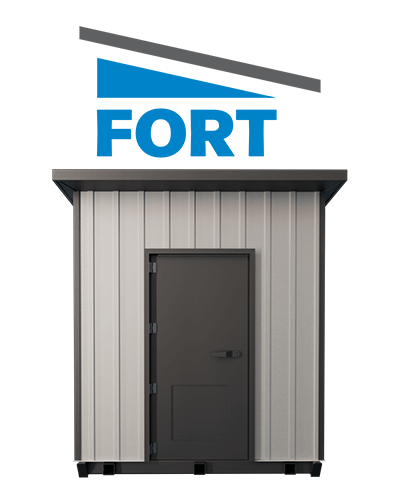 The FORT was designed, developed, and patented by engineers with decades of experience building refuge chambers for the mining and tunneling industries — applications where atmospheric chemistry, heat exposure, and occupancy duration requirements are as demanding as anything a wildfire creates. The FORT isn't adapted from another product category. Every design decision reflects the specific conditions of a residential wildfire burnover.
The standard unit accommodates up to 8 people and provides 4 hours of breathable air through a pressurized cylinder system that maintains oxygen between 18.5 and 23 percent and carbon dioxide below 1.0 percent — the same thresholds established in NIOSH and CFR 30 Part 7 standards for 96-hour mine refuge alternatives, applied to the shorter but more intense residential scenario. The life-sustaining air system is verified through testing, not estimated from general principles.
Wall construction uses EVG-3D modular panels coated with flame-resistant precast concrete — a non-combustible assembly with genuine thermal mass. The dual-door protection system pairs a burnover-rated exterior door with a specially engineered interior fire door and sealed gasket, creating the staged thermal separation that protects occupants during peak exposure. Positive pressure from the air supply actively resists smoke infiltration through any gap in the seal. The structure is above-ground by design: faster access under time pressure, simpler 6-month inspection, and better compatibility with the communication systems and Personal Locator Beacon that help emergency responders locate occupants after the fire passes.
The FORT fits alongside defensible space, home hardening, and an evacuation plan as part of a layered wildfire safety strategy — not as a replacement for any of those layers, but as the planned contingency when the others have been exhausted. Evacuation still comes first. The FORT is the prepared backup for when it doesn't go as planned.
Learn About the FORT
Quick Buyer Checklist
Before purchasing any residential wildfire refuge, run through these questions with the manufacturer or vendor. The answers reveal whether the product was built for this specific use case or adapted from something else.
- What standard was the shelter tested to, and which third-party lab performed the test? When was that certification issued?
- Does the certification cover the full system — air supply, walls, doors, penetrations — or individual components in isolation?
- What are the specific oxygen and carbon dioxide thresholds, and how long does the air supply sustain them at full rated occupancy?
- What are the maintenance requirements, and what happens to the warranty if they're not met on schedule?
- What events trigger a required out-of-cycle inspection?
- Is the structure above-ground or below-grade, and what site preparation is required before installation?
- What communication options are compatible with or built into the structure?
- What is the post-activation service process — how is the unit recertified for continued use?
A manufacturer who can answer all of those questions specifically and in writing is one whose claims can be evaluated. Vague answers — especially around testing standards and air system performance — are a signal to look more carefully before committing.
Frequently Asked Questions
Key Takeaways
- Whether fire shelters work depends entirely on what they were designed for — foil emergency wraps, storm rooms, and purpose-built wildfire refuges address different threats with different engineering
- What fire shelters are made of drives actual performance: thermal mass, sealed construction, and a pressurized air supply are the variables that matter most for a residential burnover
- NIOSH and CFR 30 Part 7 standards for refuge chambers provide the most relevant performance framework for residential wildfire applications — verify that any product references specific tested thresholds, not general claims
- Siting, occupancy planning, and maintenance are as important as construction quality — a well-built shelter placed wrong, overfilled, or poorly maintained won't perform as designed
- Above-ground purpose-built structures offer faster access, simpler maintenance, and better rescue visibility than underground alternatives
- A shelter only functions within a practiced plan — defined trigger criteria, assigned family roles, and regular drills determine whether the engineering actually protects anyone
- Evacuation remains the safest and preferred option; a refuge is the planned contingency for when that option isn't available
Final Thoughts
Asking whether fire shelters work is the right question. Getting an honest answer requires a clearer picture of which shelters, under which conditions, tested by whom, and integrated into what kind of plan. The products on the market vary enormously — not just in price and size, but in what they were actually built to do. A storm shelter is excellent at its job. So is a foil wrap in the right hands. Neither of them is a residential wildfire refuge.
For homeowners in fire-prone areas who want a genuine contingency for worst-case scenarios, the path forward is the same as any serious planning decision: understand the specific threat, verify the engineering behind any solution, and build it into a practiced plan that starts with evacuation and treats a refuge as a prepared backup — not a comfortable reason to stay behind.