Table of Contents
- What "Fireproof" Actually Means for a Home
- Roofs and Openings: Where to Start
- Fireproof Materials for Walls
- Decks, Fences, and Attachments
- Zone 0 to 100: Landscaping That Supports the Envelope
- Documentation for Insurance
- When to Consider a Refuge as Part of the Plan
- Key Takeaways
- Frequently Asked Questions
There's a gap between what homeowners think a "fireproof house" means and what building science actually says is possible. The term sounds absolute. It's not. What you're really building toward is a home that resists ignition long enough to survive a wildfire without a firefighter on site, and that's a goal worth pursuing seriously, because it's actually achievable with the right materials and the right sequence of decisions.
The 2018 Camp Fire destroyed roughly 18,000 structures in and around Paradise, California. Post-fire researchers found that homes built or retrofitted to meet ignition-resistant standards had dramatically better survival rates than their neighbors. The difference wasn't concrete bunkers. It was Class-A roofing, 1/8-inch mesh vents, and fire-rated exterior cladding: details that cost a fraction of a full rebuild, and decisions that most homeowners can still make today.
This guide walks through how to actually build or retrofit a fireproof house: which materials perform, which vulnerabilities to fix first, and how to layer your property's defenses from the foundation out. Evacuation is always the safest response to an approaching wildfire, and nothing here changes that. But a well-hardened home buys time: for you to leave, and for your property to survive.
In Short
There's no such thing as a truly fireproof house in absolute terms, but there is such a thing as an ignition-resistant one, and the gap between those 2 categories is enormous in practice. Homes hardened with Class-A roofing, ember-resistant vents, non-combustible wall cladding, and cleared Zone 0 landscaping consistently outperform unhardened homes in wildfire events. The materials exist. The installation methods are well-established. And for homeowners in high-risk areas, working through this checklist systematically is one of the most concrete things you can do to protect what you've built.
A hardened home fits naturally alongside broader wildfire preparedness: evacuation planning, defensible space, family communication plans, and for some properties, an on-site refuge option like the FORT®. None of these layers replaces the others. Together, they're what a real wildfire plan looks like.
What "Fireproof" Actually Means for a Home
Walk into any home improvement store and you'll see products marketed as fireproof. Fireproof insulation. Fireproof paint. Fireproof caulk. The word is doing a lot of work it can't back up.
Building codes don't use "fireproof" as a standard. What they do use: ignition-resistant, non-combustible, and fire-rated. These aren't interchangeable, and understanding the difference matters before you spend a dollar on materials.
Non-combustible means a material won't catch fire when exposed to flame. Concrete block, steel studs, fiber cement board. These materials physically cannot ignite. That's a high bar, and most residential construction doesn't meet it everywhere.
Ignition-resistant is the more practical category. These materials can technically burn, but they resist ignition under standard wildfire exposure conditions long enough to matter. California's WUI (Wildland-Urban Interface) building code, Chapter 7A, sets specific standards for ignition-resistant construction, and it's the standard that most fire researchers point to as the right benchmark for homes in fire-prone areas.
Fire-rated usually refers to how long a material or assembly holds up in a standardized fire test. A 1-hour fire-rated wall assembly means it maintained structural integrity for an hour under test conditions. Useful for commercial construction and interior separations. Less directly applicable to exterior wildfire performance, where the threats are radiant heat, direct flame contact, and ember intrusion rather than a controlled burn.
So when you see "fireproof house" in a search, what you're actually looking for is a home built or retrofitted to ignition-resistant standards. That's the honest, achievable goal.
Roofs and Openings: Where to Start
If you've got a limited budget for fire hardening, spend it on the roof and the openings first. Every fire researcher who has studied post-wildfire housing patterns says the same thing: most homes don't ignite from direct flame contact. They ignite from embers landing in vulnerable spots.
The roof is the largest horizontal surface on your house. It collects debris. Wind-driven embers settle into gutters, sit against fascia boards, land in valleys between roof planes. A combustible roof is the single highest-risk feature on a home in a fire-prone area.
Class-A Roofing
Class A is the highest fire-resistance rating for roofing materials, established by ASTM E108 testing. Metal roofing, concrete tile, clay tile, and certain treated wood shakes all qualify. Asphalt architectural shingles can qualify too, though not all do. Check the product's fire rating specifically, not just the brand. Replacing a roof is expensive, but if yours is wood shake or a product without a Class A rating, it's the highest-priority upgrade on this entire list.
Ember-Resistant Vents
Vents are where embers get in. Soffit vents, gable vents, foundation vents, ridge vents: these openings are designed for airflow, and they're also a direct pathway into your attic and crawlspace. Once an ember reaches your attic, you've likely lost the structure regardless of how good everything else is.
The solution can be an 1/8-inch corrosion-resistant mesh. Mesh finer than 1/8 inch restricts airflow and can cause moisture problems. Coarser than 1/8 inch lets embers through. Retrofit vent covers with the right mesh are available for most standard vent sizes, and this is one of the lower-cost upgrades with outsized impact. Some California counties now require ember-resistant vents for new construction in high-severity fire zones. If you're retrofitting an older home, this is a weekend project.
Windows and Doors
Single-pane windows fail from radiant heat, sometimes before flames are close. Dual-pane tempered glass holds up significantly longer. Multi-pane windows with fire-rated frames are even better, though those start to get expensive.
The bigger risk for most homes is the transition zones: where the door frame meets siding, where a garage door doesn't fully seal at the bottom. Weatherstripping that actually seals, door sweeps, and fire-rated caulk around frames are cheap and effective.
Fireproof Materials for Walls
Once the roof and openings are addressed, the exterior walls are next. There are several non-combustible and ignition-resistant cladding materials that look excellent on a well-designed home. Protection and aesthetics aren't a trade-off here.
Fiber Cement Siding
Fiber cement (James Hardie is the most recognized brand) is a composite of cement, sand, and cellulose fibers. It's genuinely non-combustible and holds up well against direct flame and radiant heat. It takes paint well and can be manufactured to mimic wood grain convincingly enough that it's become the standard recommendation for fire-zone homes that want a traditional look.
Cost runs roughly $6–12 per square foot installed, depending on profile and region. It's heavier than wood and needs proper fastening and painting schedules, but maintenance is low compared to wood siding in fire-prone dry climates.
Stucco
Three-coat traditional stucco is non-combustible and has a long track record in California fire zones. The critical detail is installation: stucco applied over a combustible substrate (like OSB sheathing) with gaps at penetrations still has ignition pathways. The stucco itself won't burn, but flames and embers can exploit poorly sealed interfaces. Proper installation with non-combustible sheathing and careful attention to penetrations and transitions is what makes stucco actually perform. One-coat synthetic stucco systems vary more in fire performance and should be specified carefully.
Metal Panel and Stone Veneer
Metal panel siding is non-combustible and durable. It reads as contemporary or industrial depending on profile, making it a better fit for some properties than others. Stone veneer (real or manufactured) is also non-combustible and can be used as an accent or primary cladding. Both are higher-cost options but perform well in fire environments.
What to avoid: vinyl siding melts and burns. Cedar and redwood, despite their appeal in Western residential design, are combustible without chemical treatment, and that treatment degrades over time. If you have wood siding and aren't ready to replace it, at minimum make sure Zone 0 around the house is completely clear.
Decks, Fences, and Attachments
Decks catch people off guard. The house gets hardened, the roof gets replaced, the vents get upgraded. And then a wood deck attached to the back of the house becomes the ignition pathway.
Wood decks attached to the home act as a continuous fuel bridge from vegetation to the wall assembly. Embers land on the deck, ignite wood furniture or the deck boards themselves, and fire travels directly to the house structure. This is a well-documented failure mode.
Composite decking (Trex and similar products) has significantly better fire performance than pressure-treated wood. Some composite products carry a Class A fire rating for surface spread of flame. Under-deck screening also matters: the cavity under an elevated deck traps embers and debris. Metal mesh skirting or a solid non-combustible soffit underneath eliminates that trap.
Fences are another continuous fuel path. A wood fence connected to your house runs from the property line to the exterior wall: essentially a fuse. Replacing the last 5–10 feet of fence adjacent to the structure with a metal gate or non-combustible material (concrete block, steel picket) breaks that continuity. It's called a "gate transition" in defensible space planning, and it's a small intervention with meaningful impact.
The same principle applies to wood trellises, pergolas, and attached structures. Anything combustible that physically touches the house is a liability.
Zone 0 to 100: Landscaping That Supports the Envelope
Home hardening and defensible space aren't separate projects. A Class-A roof with wood mulch piled against the foundation is a compromised system.
The zone framework gives homeowners a clear way to think about the property as a graduated buffer.
Zone 0 (0–5 feet from the structure) is the most critical. CAL FIRE and most fire researchers now treat this as the primary ignition zone for homes. Embers land here and ignite combustible materials directly against the house. Zone 0 should have no combustible mulch, no wood furniture, no propane tanks, no dead vegetation. Replace wood mulch with gravel, decomposed granite, or concrete. Move all combustibles at least 5 feet from the structure.
Zone 1 (5–30 feet) is maintained for reduced fuel load. Plants are spaced, pruned, and selected for low flammability. No continuous horizontal fuel beds. Grass is kept short and green during fire season.
Zone 2 (30–100 feet) focuses on separating tree canopies to prevent crown fire spread and removing ladder fuels (shrubs and low branches that let surface fires climb into the canopy). At 100 feet and beyond, the priority shifts to maintaining access routes and addressing any large vegetation masses that could generate ember showers.
For full defensible space planning at larger lot scale, see the detailed guide on wildfire prevention strategies and property-level fuel management.
Documentation for Insurance
Hardening your home matters for insurance in 2 ways: it may affect your coverage availability in high-risk areas, and it's documentation that adjusters and underwriters increasingly ask for when you're applying, renewing, or filing claims.
In California, AB-38 requires sellers to disclose home hardening features. The LE-100 form (used by some insurers) documents mitigation measures as part of underwriting. The details vary by insurer, but the direction is consistent: mitigation documentation helps, and the absence of it can hurt.
The practical step is a photo log. Before any retrofit, photograph the existing conditions. After, photograph the completed work. Keep receipts for materials and contractor invoices. Store digital copies in the cloud, but also think about protecting physical copies of critical documents in case your home is damaged or destroyed.
That includes insurance policies, passports, property records, family identification documents, hard drives, backup media, and other irreplaceable items that may be difficult to recover after a wildfire. For homeowners who own a FORT®, the shelter can also serve as a protected storage location for these valuables and documents during evacuation, helping preserve not only lives, but the records and possessions needed to rebuild afterward.
For homeowners in high-severity fire zones who've done significant work, it's worth a direct conversation with your insurer about how that documentation affects your coverage options. A thorough evacuation checklist is another document worth keeping updated and readily accessible as part of your overall wildfire preparedness plan.
When to Consider a Refuge as Part of the Plan
A well-hardened home substantially improves your odds. But wildfire behavior is unpredictable in ways that no single mitigation strategy fully accounts for. Extreme fire conditions, wind shifts, and rapid spread can create situations where even hardened homes face overwhelming exposure, and where evacuation routes are cut off before residents have time to leave.
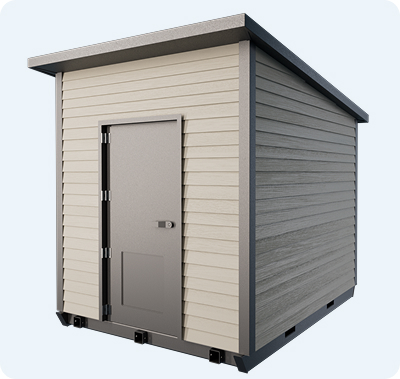
For some homeowners, particularly those on properties with limited egress, those who care for family members with mobility limitations, or those who've simply thought carefully about worst-case scenarios, adding an on-site refuge to the plan makes sense. The FORT is a purpose-built, above-ground wildfire refuge structure engineered with heat-resistant construction, a managed air system that maintains breathable conditions, and a sealed design to limit smoke intrusion. It's sized for family use and built specifically for wildfire exposure, unlike storm shelters or security safe rooms that weren't designed for this threat environment.
The FORT fits within a layered wildfire strategy that includes home hardening, defensible space, and evacuation planning. It doesn't replace any of those layers. For homes that have been hardened, cleared, and prepared for evacuation, the FORT is what you add when you want to account for the scenarios where all of that still isn't enough. If you're also evaluating a fireproof safe room as part of your property planning, it's worth understanding how those 2 options differ in design intent and wildfire performance before making a decision.
Learn About the FORT
Frequently Asked Questions
Key Takeaways
- "Fireproof" isn't a building code standard: ignition-resistant is the right goal, and it's achievable
- Roof and vent upgrades come first: Class-A roofing and 1/8-inch mesh vents address the highest-probability ignition pathway
- Fiber cement, stucco, and metal panel are the top choices for fireproof materials for walls
- Decks and fences are fuel paths to the house: composite decking, under-deck screening, and gate transitions break the continuity
- Zone 0 (0–5 feet from the structure) is where most homes ignite; clear it completely of combustibles
- Document all mitigation work with photos and receipts; this matters at claim time and for insurance underwriting
- Home hardening works best as one layer in a broader plan that includes defensible space, evacuation readiness, and for some properties, an on-site refuge option
Final Thoughts
The goal isn't a perfect house. It's a house that performs better under real fire conditions than an unhardened one, giving you and your family the time you need to get out safely. Replacing wood siding, adding 1/8-inch mesh vent covers, keeping Zone 0 clear: these are decisions that actually change outcomes in fire events. The research backs that up clearly.
Start with the roof and the openings. Work outward from there. Document as you go. And make sure the rest of your plan (evacuation routes, family communication, go-bag, and if warranted, an on-site refuge) is equally thought through. A hardened home and a layered plan go together. For homeowners who want to understand where a purpose-built refuge fits within that plan, the FORT is worth a closer look.