Table of Contents
- What Residential Wildfire Protection Means for a High-Value Home
- Start With the Envelope and the Grounds
- Wildfire Protection Systems at Estate Scale
- Wildfire Sprinkler Systems: What They Do Well and Where They Fall Short
- How to Vet Residential Wildfire Protection Companies
- Documentation for Insurers
- Where the FORT Fits in an Estate Protection Plan
- Frequently Asked Questions
- Key Takeaways
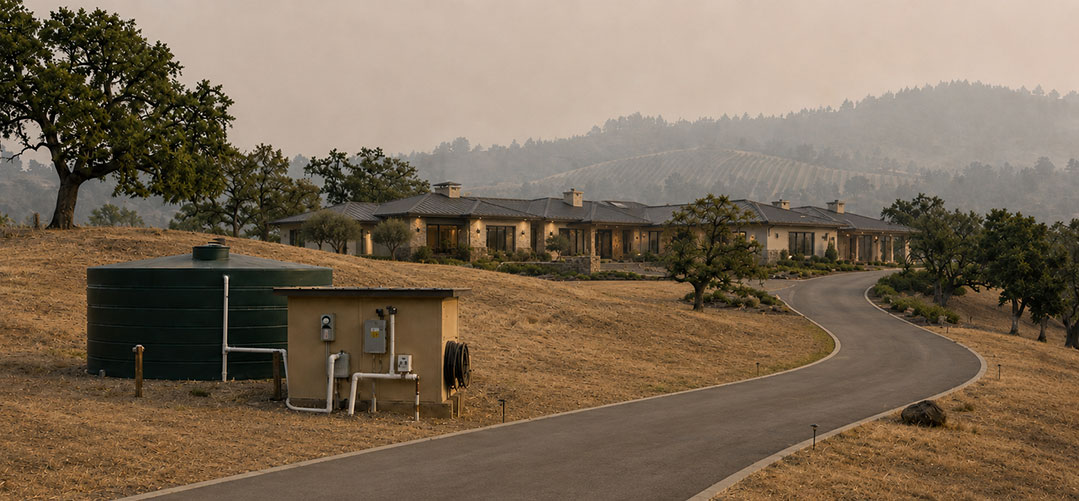
The estate manager of a 40-acre property in the Sonoma hills spends the last week of every June the same way: walking the fence lines with a clipboard, testing the generator, and checking whether the pump house still primes on the first try. She's not being paranoid. She's read the red flag forecast, and she knows that when a fire starts moving through the grass on the other side of the ridge, the property will have to do most of its own defending. Fire crews triage. Large rural parcels are rarely first in line.
That's the reality residential wildfire protection is built for. If you own or manage a high-value property in fire country, whether it's a vineyard estate, a ranch, or a large home on a wooded lot, you're planning for a fire that arrives when nobody's coming to help. The good news is that this kind of protection is a solvable design problem, and most of it is proven, unglamorous work: hardened surfaces, cleared ground, stored water, and equipment that runs when the power fails.
One thing before any of it: evacuation is always the safest choice. Every system described in this guide exists to protect the property and to buy time, never to justify staying behind. Leave early, follow official guidance, and let the plan you've built do its work without you.
In Short
Residential wildfire protection is a layered system, built from a hardened home, managed defensible space, water and power infrastructure that works without utilities, and a clear plan for the people on the property. No single product covers all 4 layers, and any company selling one that claims to should be questioned closely.
For property owners planning the people-protection layer alongside the property layers, an on-site refuge option like the FORT® works alongside evacuation planning and home hardening as part of a complete strategy.
What Residential Wildfire Protection Means for a High-Value Home
Residential wildfire protection is the full set of measures that reduce a property's chance of igniting and improve outcomes for the people on it: hardened construction, defensible space, water and power systems, detection, and emergency planning. On a standard suburban lot, most of that list collapses into a weekend project schedule. On an estate, each layer becomes real infrastructure with real engineering decisions behind it.
The scale is what changes the problem. A 40-acre parcel might have a main residence, guest houses, barns, equipment sheds, and staff quarters, each one a separate ignition risk. Water has to reach all of it. Power has to survive a utility shutoff, because California utilities now de-energize lines during extreme fire weather, which means the grid is most likely to be off at exactly the moment you need pumps running.
Protection planning for a property like this starts with a risk assessment (slope, prevailing wind, fuel loads, access roads) and builds layers in order of what actually prevents ignition. That order matters, and it's where a lot of expensive projects go wrong.
Start With the Envelope and the Grounds
Active protection systems only make sense on a property that's already hardened and cleared. Sprinklers wetting a cedar roof with open eave vents are treating the symptom while the disease walks in through the attic. Research from IBHS consistently shows that most homes lost in wildfires ignite from embers, and embers exploit construction details: vents, gutters, decks, siding gaps.
So the first 2 layers of residential wildfire protection are the ones we've covered in depth already this quarter. Hardening the structure itself is the subject of our guide to discreet home hardening retrofits for high-value properties, and cladding decisions get their own treatment in our fire resistant siding guide for luxury homes. The ground layer, managing vegetation and fuels at estate scale, is covered in our estate-grade defensible space guide for vineyards, ranches, and large lots.
With those layers in place, active systems can do what they're actually good at: extending the protection of a property that's already hard to ignite.
Wildfire Protection Systems at Estate Scale
An estate-scale wildfire protection system has 4 working parts: stored water, the pumps and power to move it, detection to trigger action early, and monitoring so someone is watching when you're not there.
Water supply
Stored water is the foundation, because municipal pressure drops or disappears during major fires when demand spikes and infrastructure fails. Dedicated cisterns for fire protection on large properties commonly run from 2,500 to 10,000 gallons or more, sized to the sprinkler demand and the structures being protected. A swimming pool holds 20,000 gallons or more and can serve as a supply if it's plumbed for drafting, meaning a fitting that lets a pump or a fire engine pull water directly from it. Some counties offer standardized hydrant or drafting connections for exactly this purpose; it's worth asking your local fire authority what their engines can hook into.
Pumps and backup power
Water without pressure is decoration. Estate systems typically pair a primary electric pump with a diesel or propane backup, or run the whole system on an engine-driven pump that doesn't care what the grid is doing. Generator sizing needs to account for pump startup loads, not just running loads, and the fuel supply needs to match the runtime you're designing for. A system that protects for 30 minutes and then goes quiet during a 6-hour ember storm wasn't designed for the actual threat.
Detection and sensors
Early warning converts a plan into action. Options range from heat and smoke sensors on outbuildings to camera systems with fire detection, and at the regional scale, services that watch satellite and camera networks and push alerts for your specific location. None of it replaces official alerts. Sign up for county emergency notifications first, and treat understanding red flag warnings as the baseline skill; property-level detection buys minutes on top of that, and minutes are what early evacuation runs on.
Monitoring and remote activation
High-value properties are often unoccupied when fire arrives. Owners travel. Staff evacuate, as they should. Systems that can be activated remotely, or that trigger automatically on detection, close the gap between "the property has protection" and "the protection actually ran." Monitoring contracts with response protocols are worth evaluating for properties that sit empty for weeks at a stretch.
Wildfire Sprinkler Systems: What They Do Well and Where They Fall Short
Exterior wildfire sprinklers do one thing well: they raise the moisture level of everything near the structure during ember exposure, which makes ignition meaningfully less likely. Roof lines, eaves, decks, and the vegetation in the first few feet around the house all become harder to light. For ember-driven fire, which is how most homes ignite, that's a real benefit.
The limits deserve equal attention. Sprinklers demand serious water: a whole-home exterior system can draw 30 to 50 gallons per minute, which drains a 5,000-gallon cistern in under 2 hours. High wind, which is the defining condition of catastrophic fire weather, blows spray off target and dries surfaces nearly as fast as they're wetted. And a sprinkler system does nothing about the flame front itself; against direct flame contact and sustained radiant heat, wet siding buys seconds, and a hardened wall assembly buys the fight.
The honest way to evaluate a sprinkler system is as a supplement for a hardened, cleared property with generous stored water, activated early and left to run while everyone leaves. Evaluated as a primary defense for an unhardened home, it fails the math on water, wind, and time.
How to Vet Residential Wildfire Protection Companies
The residential wildfire protection industry has grown fast, and quality ranges from fire-protection engineers to landscaping crews with a new truck wrap. The vetting process is the same one you'd run for any consequential contractor, with a few fire-specific additions.
Ask every candidate the same set of questions. Will the design be reviewed or stamped by a fire protection engineer? What standards does the installation follow, and can they point to them specifically (NFPA 1142 for water supply is one to listen for)? How is the system tested after install, and who maintains it on what schedule? What's the designed runtime under full load, and what happens when it's exhausted? Can they provide references from properties comparable to yours, and will they coordinate with your insurer's documentation requirements?
The red flags are just as diagnostic. Walk away from anyone who guarantees the home will survive, who sells a single product as complete protection, who won't put runtime numbers in writing, or who pitches their system as an alternative to evacuating. Reputable providers are consistent on that last point, because everyone in this field knows the systems are built to work while the property is empty.
A useful calibration before those conversations: our own overview of wildfire protection services outlines how we think about layered protection, and it's a reasonable benchmark for how any serious provider should talk about the problem.
Documentation for Insurers
Insurance is where protection investments either pay twice or leave money on the table. California's Safer from Wildfires framework requires insurers to recognize documented mitigation, and carriers writing high-value homes in fire zones increasingly want evidence, and sometimes inspections, before binding or renewing coverage.
Build the file as the work happens: system specifications and engineering documents, photos of installed equipment, pump test results, maintenance logs with dates, and receipts. Pair it with the property-level documentation covered in our home hardening guide (retrofit records, defensible space inspection results). A broker who specializes in high-value properties in wildfire regions will know which carriers give real credit for active systems, and the documentation file is what makes that conversation short.
Where the FORT Fits in an Estate Protection Plan
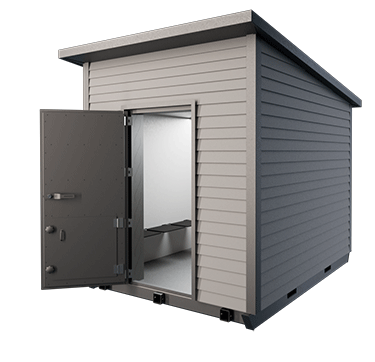 Everything above protects the property. The remaining question in any serious plan is what protects the people if a fire outruns the plan. Roads close, fires spot miles ahead of the front, and evacuation windows can shut faster than a large property can empty out, especially with staff, guests, or family members with limited mobility.
The FORT is designed as the people-protection layer for exactly that scenario: a purpose-built, above-ground refuge with sealed, heat-resistant construction and a managed air system that maintains breathable air for a defined duration. It's engineered specifically for wildfire conditions, which distinguishes it from storm shelters, security rooms, and repurposed structures that were built for different threats. On an estate, it also serves a second role: secure on-site storage for irreplaceable items ahead of an evacuation, which makes the decision to leave early easier, and earlier.
The FORT works alongside evacuation planning, home hardening, and the systems described in this guide, as one component of a layered strategy. The first move in every fire plan is still to leave early. What the FORT changes is the plan's answer for the scenario nobody schedules.
Learn About the FORT
Frequently Asked Questions
Wildfire protection systems can support premium discounts and improve insurability, particularly in California under the Safer from Wildfires framework, but credit varies by carrier and depends on documentation. Keep system specifications, photos, pump test results, and maintenance logs, and work with a broker who knows which carriers recognize active protection systems on high-value homes.
Wildfire sprinkler systems are effective at reducing ember ignition when they're paired with a hardened home, adequate stored water, and early activation. They wet roofs, decks, and nearby vegetation so embers are less likely to start a fire. They are far less effective against direct flame and radiant heat, in high wind, or on properties without enough water to sustain 30 to 50 gallons per minute for the duration of an ember storm.
Choose a residential wildfire protection company by asking for engineering credentials, the specific standards the design follows, written runtime numbers under full load, a testing and maintenance schedule, and references from comparable properties. Avoid any provider who guarantees survival, sells one product as complete protection, or positions their system as an alternative to evacuation.
Residential wildfire protection is the combination of hardened construction, defensible space, water and power systems, detection, and emergency planning that reduces a home's chance of igniting during a wildfire. On large or high-value properties it typically includes dedicated water storage, backup-powered pumps, and exterior sprinkler or spray systems, layered on top of a hardened structure and managed vegetation.
A wildfire protection system defends the property: water, pumps, sprinklers, and sensors that reduce the chance of ignition. A wildfire shelter protects people. A purpose-built refuge like the FORT provides sealed, heat-resistant protection with a managed air supply for situations where evacuation is no longer possible, and it belongs in a plan as a complement to protection systems and evacuation planning, never as a replacement for either.
Key Takeaways
- Residential wildfire protection is 4 layers: hardened structure, defensible space, water and power systems, and a people plan
- Active systems only earn their cost on a property that's already hardened and cleared
- Stored water is the foundation; grid power and municipal pressure both fail during major fires
- Sprinklers reduce ember ignition but lose to wind, direct flame, and small cisterns
- Vet providers on engineering credentials, written runtime numbers, and maintenance schedules
- Document everything for insurers as the work happens, not after
- Evacuation stays the first move in every plan; systems are built to work while the property is empty
Final Thoughts
Residential wildfire protection at the estate scale rewards the same discipline as any other serious infrastructure decision: assess the risk, sequence the layers in order of what prevents ignition, size the systems to the real threat duration, and write everything down. Most of the expensive mistakes in this field come from buying hardware before doing the first 2 steps.
The property layers are only half the plan. For the scenario where people are still on site when the window closes, an on-site refuge like the FORT gives the plan an answer it otherwise doesn't have. Build the layers, drill the plan, and let evacuation stay the move you never have to improvise.