
Table of Contents
Fire protection is often reduced to a product decision. People buy a “fireproof” safe, a fireproof bag, or a security system and assume they are covered. But real fire protection is broader and more disciplined than that. It is a layered strategy designed to protect people first, reduce structural risk where possible, and preserve the proof you’ll need to recover afterward.
Across fire agencies and wildfire safety organizations, the guidance is remarkably consistent: plan for safety and evacuation first, then secure what you can without slowing down your ability to leave. A practical fire protection plan addresses prevention, preparation, response, and recovery—not just storage devices or last-minute packing.
In wildfire-prone regions, fire protection becomes more complex than “store it in a safe.” Wildfires can expose homes to radiant heat, ember intrusion, and heavy smoke for extended periods. That changes how safes perform, how documents survive, and how quickly you can rebuild your life afterward. Even in non-wildfire scenarios, the basics (alerts, escape planning, and reducing ignition sources) set the foundation for everything else.
This guide explains what fire protection really covers, how to evaluate safes and certification claims, where placement matters, and how to build redundancy into your plan so you can keep your valuables and your loved ones safe.
“Preparedness saves lives. Clearing defensible space, hardening your home, and preparing an evacuation plan are just as important as investing in protection.
— Mike Wilson, Retired CalFire Firefighter
Summary
Fire protection starts with people: alerts, an evacuation plan, and prevention steps that reduce ignition risk. From there, it extends to protecting valuables, legal records, and digital data using a layered approach.
Fire-resistant safes can slow heat transfer, but they are not immune to prolonged wildfire exposure, smoke infiltration, water damage, or structural collapse. Ratings matter, but they only mean something when you understand what was tested and what wasn’t.
The most reliable approach is redundancy: keep critical records in more than one place, maintain encrypted cloud backups, and build an insurance-ready inventory.
Finally, in situations when evacuation becomes impossible, a purpose-built refuge like FORT® can temporarily protect both people and valuables stored inside—while still keeping evacuation as the priority.
What Fire Protection Covers
Fire protection isn’t one thing—it’s a system. When you zoom out, it usually falls into three buckets: protecting people, reducing property risk, and protecting proof (records, documentation, and the details you need to recover). A good plan covers all three, in that order.
People first. That means early awareness, clear decision-making, and the ability to leave quickly. Many fire districts emphasize the same principle: prioritize safety, and only secure belongings in ways that don’t slow evacuation. The Boulder Mountain Fire Protection District puts that priority plainly. And broader home-focused resources like OBFD’s safety guidance reinforce practical measures that support life safety—alarms, escape planning, and proactive habits that reduce risk before an emergency happens.
Property risk reduction. This includes home hardening and mitigation. For wildfire specifically, agencies highlight ember resistance and defensible space because embers can ignite a structure even when flames never directly touch it. The National Interagency Fire Center’s wildfire mitigation guidance summarizes home-focused steps like maintaining roofs and gutters, reducing combustible materials near the structure, and improving the home’s ability to resist ember intrusion.
Proof and recovery readiness. Even when people evacuate safely, a fire can disrupt your finances, access to services, and ability to prove ownership or coverage. The ADT fireproofing guide emphasizes protecting vital records and preparedness as part of a complete plan. In practice, “proof” includes insurance policies, IDs, deeds, medical records, serial numbers, and a current inventory of valuables.
One helpful way to sanity-check your plan is to ask four questions and make sure you have an answer for each:
- How do we get out fast? (alerts, routes, meeting points, go-bags)
- How do we reduce ignition risk? (mitigation and home hardening)
- What is truly irreplaceable? (sentimental items, legal records)
- What must be duplicated? (records, photos, inventory, backups)
Safes belong in the “protect what you can” layer. They can be useful. But a safe is never a substitute for evacuation planning, mitigation, and redundancy.
Wildfires vs. House Fires
Many consumer fire-resistant products are tested to simulate aspects of a house fire under controlled conditions. Wildfires often involve different exposure patterns. Instead of a short-duration interior fire, wildfire threats can include radiant heat from outside the structure, ember intrusion that ignites hidden areas, and smoke that saturates materials for hours.
The NIFC wildfire mitigation guidance emphasizes how embers can be a primary driver of home ignition. That matters because embers can enter through vents, gaps, and weak points, igniting attics, crawlspaces, or other concealed areas. Once a structure ignites, conditions can change quickly—and the duration of high heat exposure can be longer than a typical residential fire scenario.
Wildfire conditions may also come with heavy smoke and fluctuating oxygen levels around the structure. Even if a safe survives heat exposure, smoke and soot can penetrate seams and vents, staining paper and ruining electronics. Water used in suppression can flood rooms, soak documents, and create mold risk during the recovery period. That’s why “fire protection” can’t be just one layer. It has to account for heat, smoke, water, and access.
It’s also why language matters. “Fireproof” is a common marketing term, but it can imply guarantees that don’t exist. Fire ratings usually describe performance in a specific test for a specific time at a specific temperature curve—not a promise that contents will survive all fire scenarios. Comprehensive planning guidance like SRFEI’s fire safety plan encourages layered, realistic planning rather than reliance on a single product or assumption.
Safe Types
Not all safes are built for the same job. If you’re trying to protect valuables, records, and irreplaceable items, it helps to think in categories: general home safes, gun safes, and document/media safes. Each category has strengths, limitations, and common misuse patterns that can lead to disappointment after a major event.
General Home Safes
General home safes typically prioritize theft resistance. Some include fire resistance, but the level varies widely. These can be a good fit for jewelry, small valuables, passports, and cash—especially when you want to keep items organized and protected from casual theft. Many homeowners also use general safes for short-term document storage, but that can become risky if the safe’s temperature rating isn’t designed for paper, or if the safe is placed in a location that experiences higher heat exposure.
Product-focused resources recommend verifying reputable ratings and understanding what a product is designed to do. A general safe can be a helpful layer, but for critical records it’s usually better to add document-specific protection and off-site backups.
Fireproof Gun Safes
Traditional consumer safes are engineered primarily for secure firearm storage and access control. Fire resistance may be included, but it’s often secondary to security features such as thicker steel, locking mechanisms, and anti-pry design. That doesn’t mean a gun safe can’t help with fire protection—it can—but it does mean you should interpret the fire claims carefully and avoid assuming the safe is optimized for documents or digital media.
Two practical issues come up repeatedly with gun safes. First, time-and-temperature claims can be misunderstood. A “60-minute” rating doesn’t mean the safe survives every 60-minute scenario; it reflects a specific test. Second, insulation and sealing can create humidity problems. Moisture trapped inside a safe can affect firearms, paper, and photographs over time. If a gun safe is part of your plan, consider humidity control (desiccants or an active dehumidifier) and avoid using it as your only repository for records.
From a wildfire perspective, think about the full exposure: radiant heat, smoke infiltration, and the possibility of structural compromise. Even if the safe slows heat transfer, contents may be damaged by smoke, water, or collapse. This is one reason comprehensive planning could integrate more sophisticated solutions like a wildfire bunker to protect people and valuables.
Learn more about Fireproof Gun Safes
Fireproof Document & Media Safes
Document safes are designed with paper and media in mind. They aim to keep internal temperatures below thresholds that damage paper (often associated with Class 350 ratings) and, for media-rated safes, even lower thresholds that protect digital storage devices. If your priority includes birth certificates, passports, insurance policies, estate documents, property deeds, or backup drives, a document/media safe can be a more appropriate layer than a general safe.
That said, document safes often come with tradeoffs. Capacity can be limited, and the best-performing models can be heavy and difficult to move. It’s also important to remember that a document safe protects against a specific set of conditions for a specific duration. In a severe wildfire with prolonged exposure, smoke infiltration, or collapse, a document safe will not be enough on its own. That’s why safety resources that focus on preparedness and recovery often pair “protect the originals” with “duplicate the essentials” using digital and off-site storage. Some property owners also integrate a purpose-built refuge structure like the FORT® into their plan so protection does not rely soley on the surrounding structure.
Learn more about Fireproof Document Safes
Understanding Ratings
When people shop for fire protection products, “fireproof” is the word they see most often. In practice, most consumer products are better described as fire-resistant. The difference matters because “fire-resistant” implies a tested threshold under defined conditions—not an all-scenarios guarantee.
Independent certifications (often associated with UL classifications) describe what internal temperature a safe is designed to maintain and for how long. Common references include categories often associated with protecting paper or protecting digital media at lower internal temperatures. Even when a product lists a time rating—30, 60, 120 minutes—you still need to interpret it in context: what was the external temperature, what was the heat curve, and what assumptions were built into the test?
Water protection is another major factor. Suppression efforts can introduce water damage, and post-fire conditions can include soaked floors, humidity, and mold risk. The ADT fireproofing guide calls out the importance of protecting records not only from heat but also from water exposure, which is common during and after firefighting operations. For practical planning, look for clear statements on whether a product is water-resistant or waterproof and what that actually means.
To keep your shopping process grounded, use a short checklist before purchasing:
- Internal temperature target: Does it match paper, photos, or digital media needs?
- Duration: How long is the rating, and what test is it based on?
- Independent testing: Is the rating clearly documented by a reputable third party?
- Water protection: Does it address flood/suppression exposure realistically?
- Fit for your hazard: Does it align with wildfire exposure risks in your region?
Finally, keep the “system” mindset. Ratings help you compare products, but comprehensive planning guidance emphasizes combining product choices with prevention, evacuation readiness, and recovery planning. And in regions exposed to wildfire conditions, that planning may extend beyond consumer-grade storage solutions altogether into more specifically engineered solutions.
Why Fireproof Safes Fail in Wildfires
Placement & Anchoring
Where you place a safe can be as important as what you buy. Placement affects heat exposure, collapse risk, smoke pathways, and access during a fast-moving evacuation. Many homeowners install safes where they are convenient (like a garage) without considering how fire behaves around and through a structure.
Wildfire guidance such as the NIFC home mitigation page helps explain why interior weaknesses matter. Embers can enter vents or gaps and ignite hidden areas; radiant heat can be most intense along exterior walls; and attached structures like garages can contain combustible loads. In many homes, garages store fuel, paint, solvents, propane cylinders, and other materials that increase fire intensity if ignition occurs.
Practical placement guidelines (always check your specific home constraints) often include:
- Avoid garages when possible, especially if they store combustibles.
- Favor interior locations that are buffered from exterior radiant heat.
- Prefer ground-level placement to reduce fall-and-collapse exposure.
- Anchor to a concrete slab for stability and theft deterrence.
Anchoring matters for two reasons. First, it reduces theft risk and prevents tipping. Second, after an event, a displaced safe can be harder to access safely. If you’re protecting documents or media, also think about smoke pathways. Even a well-rated safe can allow soot infiltration if it’s subjected to extreme pressure differentials or debris impacts during structural compromise.
Placement reduces predictable exposure, but it cannot change the fundamental limitation: most safes rely on the surrounding structure for protection. In contrast, FORT® is engineered as a standalone wildfire refuge, designed to withstand burnover conditions without depending on the home around it.
Bags, Boxes & Backups
Fireproof bags, fire-resistant document safes, and small lockable containers are popular because they feel actionable. They can be useful—especially as part of an evacuation routine—but they should be viewed as a mobility layer, not structural protection. Even rated safes are tested under controlled conditions and can fail in severe wildfire exposure, prolonged heat, or structural collapse. In situations where evacuation isn’t possible, a shelter like FORT® is designed to protect people—and the critical valuables brought inside—under extreme conditions.
The best use-case for a bag or portable box is to make it easier to leave quickly with the essentials you truly can’t risk losing. That aligns with the broader message in the Boulder Mountain Fire Protection District guidance: prioritize safety and only secure belongings in ways that don’t slow evacuation.
For anything high-stakes—estate documents, vital records, rare photos, expensive collections—the strongest protection is redundancy. When one layer fails, another layer carries you. A layered approach often includes:
- Off-site originals or duplicates (safe deposit box, attorney, trusted relative in another region)
- Encrypted cloud backups (scans of key documents, inventory spreadsheets, photos)
- Local backups (external drive stored in a different building or hardened location)
- Grab-and-go bundle (portable binder or bag for evacuation)
Home-focused resources emphasize protecting records as part of preparedness—not as a single solution, but as a plan that keeps you functional after an emergency.
Inventory & Insurance
If you ever need to file a major claim, documentation becomes its own form of fire protection. It doesn’t stop a fire—but it can dramatically reduce the financial and logistical damage that follows. In many households, people discover too late that they can’t quickly prove what they owned, what it was worth, or when it was purchased.
Most safety resources encourage homeowners to take steps ahead of time rather than improvising under stress. A current inventory is one of the most practical “ahead of time” actions you can take, especially for high-value items.
A strong inventory is simple and repeatable. Aim for a system you can update annually:
- Room-by-room photos: wide shots plus close-ups of high-value items.
- Video walkthrough: narrate brands, model numbers, and special features.
- Serial numbers: electronics, appliances, tools, and specialized equipment.
- Receipts and appraisals: jewelry, art, collectibles, and rare items.
- Cloud storage: keep a secure copy accessible from anywhere.
Create an “insurance dossier” folder (digital and, when appropriate, physical) that includes policy numbers, agent contact details, coverage limits, deductibles, and any special endorsements. Store a copy off-site. If your structure is lost, the ability to access coverage information quickly can reduce delays when you’re trying to secure temporary housing, replace essentials, and coordinate next steps.
Evac Binder & Grab-List
An evacuation binder is one of the most useful, low-tech tools you can build—especially for households with complex needs, multiple properties, staff, or extended family responsibilities. The goal is not to create paperwork for the sake of paperwork. The goal is speed, clarity, and reduced decision-making under stress.
We often return to a simple theme: prepare early so you don’t hesitate. Build your binder around two parts: a “must-grab” core and a “nice-to-have” supplement.
What to include in the core binder
- Identification: copies of IDs, passports, birth certificates (or a list of where originals are stored).
- Insurance essentials: policy numbers, agent contacts, coverage summaries, claim hotline numbers.
- Medical info: prescriptions, allergies, physician contacts, insurance cards.
- Critical contacts: family, neighbors, employer/estate staff contacts, out-of-area check-in person.
- Property essentials: address list, gate codes (if appropriate), utility shutoff notes, key vendor contacts.
Add a grab-list you can follow under stress
Even prepared households can freeze when the environment becomes chaotic. A short grab-list reduces the “what do we do now?” moment. Keep it realistic—items you can pick up in under 2–3 minutes.
- Go-bags and medications
- Evac binder
- Phone chargers + backup battery
- Keys, wallets, essential devices
- Pet supplies (carrier, leash, food, meds)
Store the binder near your primary exit, not in a back closet. If you use a fire-resistant document safe, consider keeping a “fast copy” of the binder materials in the safe while maintaining a grab-ready binder by the door.
Where the FORT® Fits
Fire protection begins with evacuation and mitigation. In most situations, the safest decision is to leave early and follow local guidance.
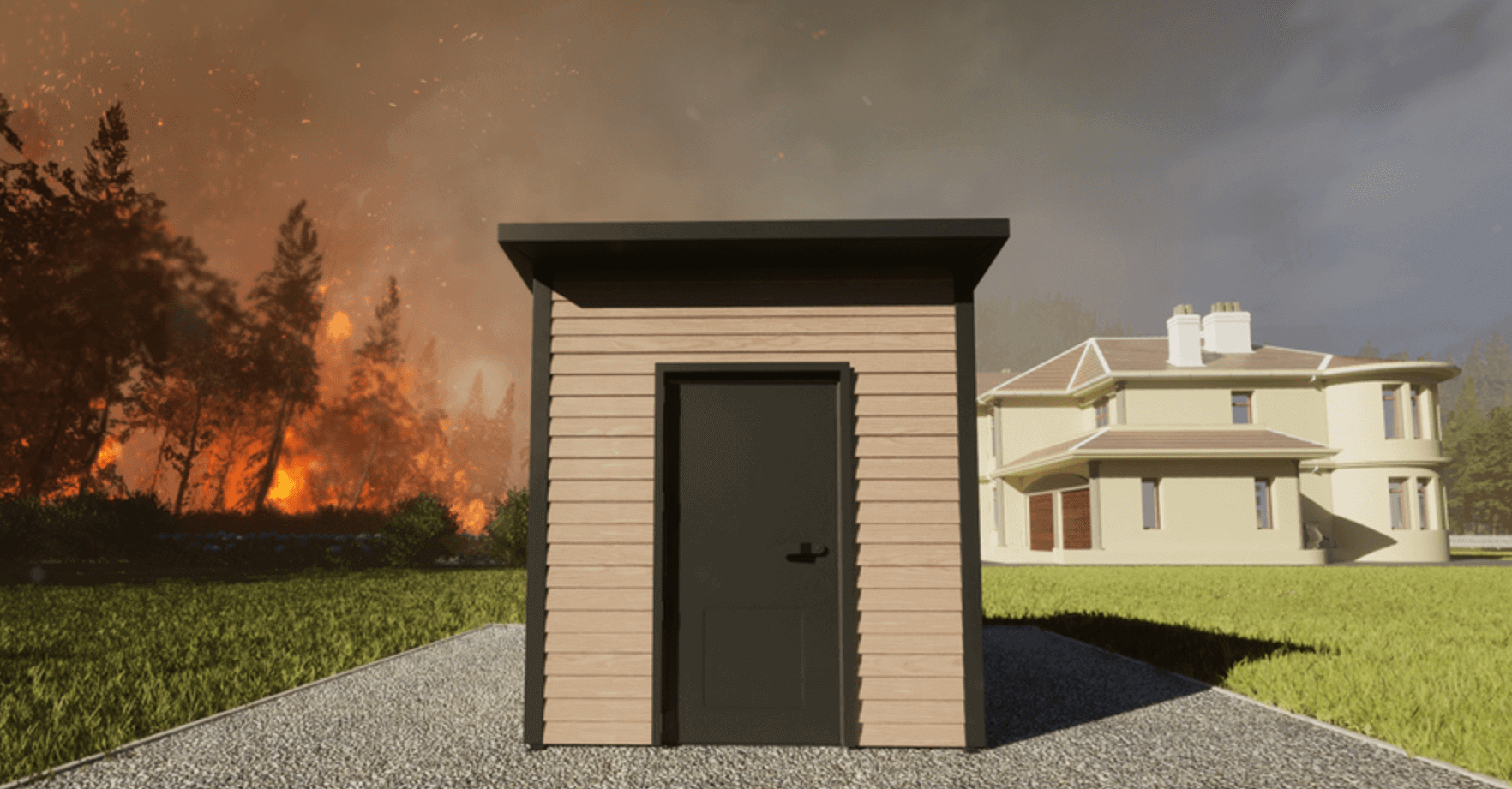
But wildfire conditions can change quickly, and scenarios exist where evacuation routes close or become unsafe. Planning responsibly means acknowledging that possibility without allowing it to replace evacuation-first thinking.
In those situations, a purpose-built refuge can add a layer of life safety. FORT® is designed to protect people during wildfire entrapment scenarios, providing temporary protection from extreme heat and smoke exposure.
Unlike consumer safes, which are designed to protect objects, a FORT® is designed around human survival needs. Because it is an enclosed refuge, it can also protect certain valuables stored inside during use—critical documents, small irreplaceables, and essentials you want with you if you must shelter temporarily.
In situations where evacuation isn’t possible, a purpose-built, tested refuge like FORT® can provide temporary protection. Always evacuate if you can; a FORT® is not a substitute for evacuation.
FAQs
Key Takeaways
- Fire protection starts with people. Alerts, evacuation readiness, and early action come first.
- Wildfires are different. Ember intrusion, radiant heat, smoke, and collapse change what “protection” means.
- Safes are one layer, not a guarantee. Ratings reflect specific tests, not every scenario.
- Placement matters. Interior, ground-level, anchored placement can reduce exposure and improve stability.
- Redundancy is the strongest protection. Off-site copies and encrypted cloud backups reduce total-loss risk.
- Documentation speeds recovery. Inventory photos, serial numbers, and an insurance dossier reduce claim friction.
- Evac binder reduces hesitation. Keep essentials organized so leaving is faster and calmer.
- FORT® can protect people and certain valuables stored inside, but never replaces evacuation.
Final Thoughts
Fire protection is not a single purchase—it’s a layered system built to protect people first, reduce ignition risk where possible, and preserve the records and proof that support recovery. Consumer safes can be valuable tools, but they have real limits in wildfire conditions, especially when exposure is prolonged or structures are compromised.
The strongest plans combine engineered structures and smart storage with redundancy: off-site copies, encrypted cloud backups, and a current inventory that makes insurance recovery faster and less stressful.
Preparedness gives you options. Evacuation gives you safety. Build a plan that helps you leave early and recover efficiently.
-1.jpg)