Table of Contents
- What Wildfire Risk Management Means for a Luxury Estate
- How to Assess Your Estate's Wildfire Exposure
- How to Harden the Property Itself
- How to Run Fire Season on an Estate
- How to Plan On-Site Refuge for When Evacuation Isn't Possible
- How to Use Insurance and Financing to Fund Mitigation
- Your 90- and 180-Day Implementation Roadmap
- Where the FORT Fits
- Frequently Asked Questions
- Key Takeaways
The owner of a 12-acre property in the hills above Sonoma already does more than most. There's a defensible-space crew twice a year, a metal roof, a property manager who watches the weather. And yet, when a fast-moving fire crossed the valley two seasons ago, the honest question wasn't "did we buy the right roof." It was "who decides what happens, and in what order, when the smoke is already here." That gap, between owning good equipment and running an actual plan, is what separates a hardened estate from a lucky one.
This guide is for owners of high-value homes, vineyards, and ranches, and for the property managers and staff who run them. Generic wildfire advice assumes a quarter-acre suburban lot with one family and one car. A large property has multiple structures, outbuildings, staff, vendors, long driveways, and assets that can't be thrown in a trunk. Wildfire risk management at that scale is its own discipline, and it rewards a system over a shopping list.
One rule sits above everything here: evacuation is always the safest choice. Leaving early, before conditions turn, is what fire officials recommend and what saves lives. Everything in this guide is built to make early evacuation more likely and to protect people and property for the narrow window when leaving isn't possible.
In Short
Wildfire risk management for a luxury estate is an ongoing program, not a one-time purchase. It works in 5 layers: assess your exposure, harden the property, operate through fire season, plan for on-site refuge, and document everything for insurance. Estates need one more thing most homeowners skip, which is a governance layer that names who owns the plan and what staff do on a red-flag day.
Where does an on-site refuge fit? It's the contingency for the scenario where evacuation isn't possible, and it belongs inside the plan alongside evacuation and home hardening, never as a substitute for leaving early. The FORT® is one on-site refuge option within that broader strategy, covered near the end of this guide.
What Wildfire Risk Management Means for a Luxury Estate
Wildfire risk management is the ongoing process of measuring your property's wildfire exposure and reducing it through layered controls, seasonal operations, and financial planning. For an estate, it's a program you run every year, the way you'd run maintenance or security.
A useful wildfire risk management framework works in layers: you assess your exposure, harden the property, operate through fire season, plan an on-site refuge, and insure and document the work. Each layer lowers risk on its own, and they compound when you run them together.
Assign an owner for the plan
Estates carry one requirement a typical home doesn't: someone has to own the plan. On a large property with staff and vendors, the usual failure mode is ambiguity about who clears the gutters before a Diablo wind event, who confirms the water tanks are full, and who decides at what point family and staff leave. Write those roles down. Name the owner of the plan (often the property manager), name a backup, and give staff a one-page playbook they can act on without waiting for a phone call that may not connect.
How to Assess Your Estate's Wildfire Exposure
You can't manage risk you haven't measured, and free public tools give you a usable baseline in under an hour. Start with the address-level map your insurer and county actually reference, add the regional data for context, then bring in someone who can walk the property. Each tool answers a different question, so use them in that order.
Check your wildfire risk score by address with the CAL FIRE zone map
California's Fire Hazard Severity Zone viewer gives you a property-level hazard rating for free, and it takes a street address directly. This is the map that drives building code requirements and shows up in insurance conversations, which makes it the most consequential number on your property.
Enter your address in the CAL FIRE Fire Hazard Severity Zone viewer and the map returns your parcel's zone: Moderate, High, or Very High. Write it down with the date, because insurers and contractors will ask for it and it belongs in the documentation file described later in this guide.
A Very High rating triggers Chapter 7A ignition-resistant construction standards for new building and for many remodels, so the zone shapes what you're required to install, not only what you're advised to install. Outside California, our roundup of the best wildfire risk maps and apps by use case covers the address-level and regional tools available in other states, including wildfire risk by zip code.
Read the regional picture in FEMA's National Risk Index
FEMA's National Risk Index rates wildfire risk by county, which is the right resolution for comparing regions and for insurance and planning context. FEMA retired the standalone Risk Index map in December 2025 and moved the data into the Resilience Analysis and Planning Tool.
You can reach the wildfire data through the FEMA Resilience Analysis and Planning Tool, where the NRI layers include a county wildfire risk rating. Fair warning: it's a mapping tool built for emergency planners rather than homeowners, so expect a few more clicks than a consumer lookup.
Read this one for the regional signal only. The wildfire ratings stop at the county line, so a single rating covers everything from valley floor to ridgeline and can't see your slope, your vegetation, or the cleared 100 feet around the main house.
See the landscape with Wildfire Risk to Communities
Wildfire Risk to Communities, a free resource from the USDA Forest Service, shows wildfire likelihood and exposure across communities and landscapes. Choose your state, then your county or named community. There's no address search here, so treat it as the view from above rather than a property lookup.
Use it to understand the terrain and fuels feeding fire toward your area, and to see whether your corner of the county carries more risk than the county average suggests. That matters most when a property backs up to open space or a wildland edge.
Get a site-specific assessment
A qualified on-site assessment reads what no map can see, and it's the step that turns a score into a work list. The tools above model risk from data. They don't walk your driveway.
An assessor evaluates the slope and how it channels fire uphill toward structures, your prevailing wind exposure, the fuel load in that stand of oaks, and whether a fire engine can actually reach the back buildings and turn around. Fire-adapted programs like Firewise USA and, in California, resources from CAL FIRE can point you to reputable assessors in your county.
| Assessment tool | What you enter | Best for | Main limitation |
|---|---|---|---|
| CAL FIRE Fire Hazard Severity Zone viewer | Full street address | A free property-level hazard zone that insurers and building codes reference | California only; hazard zones, not a modeled risk score |
| FEMA National Risk Index, inside RAPT | Address or place, then your county | Comparing regional risk; insurance and planning context | Wildfire ratings are county-level only, too coarse for a single lot |
| USFS Wildfire Risk to Communities | State, then county or community | Understanding terrain, fuels, and wildfire likelihood nearby | No address search; not specific to your parcel |
| Professional on-site assessment | A site visit | Slope, wind, fuels, and access decisions the maps can't make | Costs money and requires a qualified assessor |
How to Harden the Property Itself
Hardening the building envelope and the grounds is the highest-impact layer, because it lowers the chance the home ignites at all. Most homes that burn in a wildfire ignite from embers that land in a vulnerable spot hours before or after the fire front passes, not from a wall of flame. Close those spots and you change the outcome.
Harden the envelope
The envelope is your roof, vents, windows, and siding, and it's where embers do their damage. A Class A roof, ember-resistant vents with 1/8-inch metal mesh, and dual-pane tempered windows remove the most common entry points. On a high-value home you can do all of this without visible compromise; the retrofits that matter are mostly hidden. Our guide to discreet home hardening retrofits for high-value properties walks the envelope in detail, and fire resistant siding for luxury homes covers cladding choices that hold their look while resisting ignition. If you're planning the full sequence, our sequenced luxury estate guide to wildfire-hardening the whole property ties it together.
Build defensible space at scale
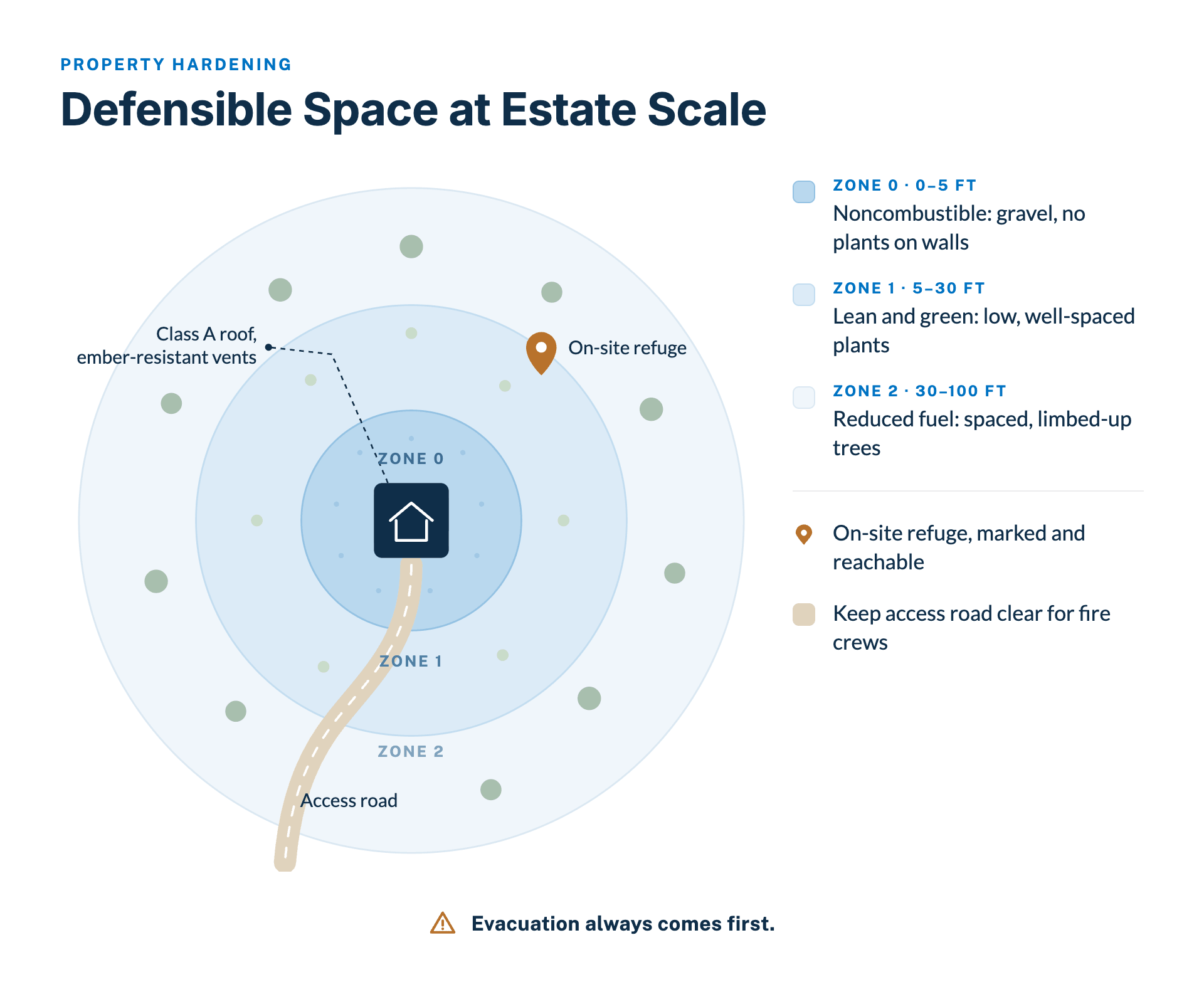
Defensible space on an estate isn't one 100-foot ring; it's a set of them, around the main house, the guest structures, the barn, and along the driveway that doubles as the fire crew's access road. The zones are the same as on any property (0 to 5 feet, 5 to 30, 30 to 100), but the execution changes across vineyards, courtyards, and outbuildings. Our estate-grade defensible space plans for vineyards, ranches, and large lots cover how to plan it at that scale without turning the grounds into a firebreak.
Add active protection systems
Once the envelope and grounds are handled, active systems earn their place: exterior sprinkler and misting setups, a dedicated water supply with cisterns and a generator-backed pump, and ember-detection sensors. These matter most on properties far from a hydrant or a station. They're an investment, and they pay off only when the passive work is already done, so sequence them last. For how to specify and vet these systems, and the companies that install them, see our guide to residential wildfire protection for high-value homes.
Residential Wildfire Protection
How to Run Fire Season on an Estate
A hardened property still needs an operating plan, because wildfire risk isn't constant; it spikes on specific days, and staff need to know what to do when it does. Running fire season is the difference between equipment that exists and equipment that's ready.
Know your regional fire-season timeline
In Napa and Sonoma, the dangerous window runs roughly from late summer through the first soaking rains, and it peaks when Diablo winds arrive in the fall. Build your calendar around that: heavy vegetation work and system checks in spring and early summer, full readiness by August, and heightened vigilance through the wind events of October and November. Our breakdown of what fire season means for Napa and Sonoma estates covers the regional timing and the staffing rhythm in depth.
What to do when a Red Flag Warning is issued
A Red Flag Warning means fire-favorable conditions are here or imminent, and it should trigger a specific, pre-written sequence on your property:
- Top off the water tanks
- Move vehicles to face out for a fast exit
- Sweep gutters and decks clear of leaf litter
- Confirm who's on site and who's reachable
- Charge devices, and check that the go-bags and a written evacuation checklist are current
Understanding what a Red Flag Warning is and preparing for one explains the trigger and the first hour. The point is that nobody should be improvising on a red-flag day; the plan already told them what to do.
How to Plan On-Site Refuge for When Evacuation Isn't Possible
Evacuation is always the safest option, and an on-site refuge is the contingency for the narrow case where it fails: roads cut off, fire moving faster than the exit, visibility gone. Planning for that case means making sure that if leaving becomes impossible, people have a protected place instead of a hallway. It is preparation for a failure of the exit, not a decision to stay.
When on-site refuge makes sense on an estate
An on-site refuge earns consideration on properties where the exit is fragile. That means a long single-access driveway, a remote parcel far from a fire station, terrain that funnels fire toward the buildings, or a household that includes people who can't move quickly. If your property has 2 easy exits onto cleared roads and a station nearby, your risk budget is better spent on hardening. If it doesn't, a refuge is worth evaluating as one layer of the plan.
Compare refuge options on what actually matters
Not every structure marketed for protection is built for a wildfire. Storm shelters are designed for wind and debris. Security safe rooms are built to keep people out. A wildfire refuge has to manage sustained radiant heat, keep smoke and gases out, and supply breathable air for hours, which is a different engineering problem. Here's how the common options compare on the criteria that decide survivability.
| Criterion | Above-ground purpose-built refuge | Underground bunker | Interior safe room |
|---|---|---|---|
| Heat and radiant protection | Engineered specifically for wildfire heat exposure | Soil provides insulation, but design and depth vary widely | Built for storms or security, not sustained wildfire heat |
| Air system | Integrated, engineered breathable-air supply | Depends on ventilation design; can draw smoke if unsealed | Typically none dedicated to wildfire conditions |
| Testing and certification | Can be third-party tested against fire and life-support standards | Highly variable; many DIY or uncertified | Rated for its original purpose, not wildfire |
| Access and rescue visibility | Direct access on the surface; visible to responders | Access can be blocked by debris; harder to locate | Inside the home, so tied to the home's survival |
| Maintenance | Inspected and serviced above ground | Drainage, corrosion, and water intrusion to manage | Minimal, but limited protection |
The pattern is consistent: an above-ground, purpose-built refuge with an engineered air system and independent testing addresses the wildfire problem more directly than a repurposed or improvised structure. For the full cost and siting picture, our guide on when an on-site refuge makes sense on an estate covers it end to end.
How to Use Insurance and Financing to Fund Mitigation
Mitigation is easier to justify when it protects both the property and the policy, and in California, insurers now have to credit specific actions. The wildfire insurance market has tightened, with non-renewals and rising premiums in high-risk areas, which makes documented mitigation a financial tool as well as a safety measure.
What insurers now credit
California's Safer from Wildfires framework requires admitted insurers to recognize specific mitigation actions, from a Class A roof and ember-resistant vents to clearing the first 5 feet around the home and maintaining defensible space. The Insurance Institute for Business & Home Safety sets the Wildfire Prepared Home standard that a growing number of insurers reference. Do the work these programs name, and you're building the case for coverage and for credit at renewal.
Document everything
Credit and claims both run on documentation, so treat records as part of the mitigation. Photograph every upgrade, keep receipts and contractor specs, log each defensible-space cycle with dates, and save your inspection reports in one place your insurer can access. A clean file speeds a claim, supports a premium argument, and gives a new insurer a reason to say yes. On a large property, assign this to one person so it doesn't scatter across inboxes.
Your 90- and 180-Day Implementation Roadmap
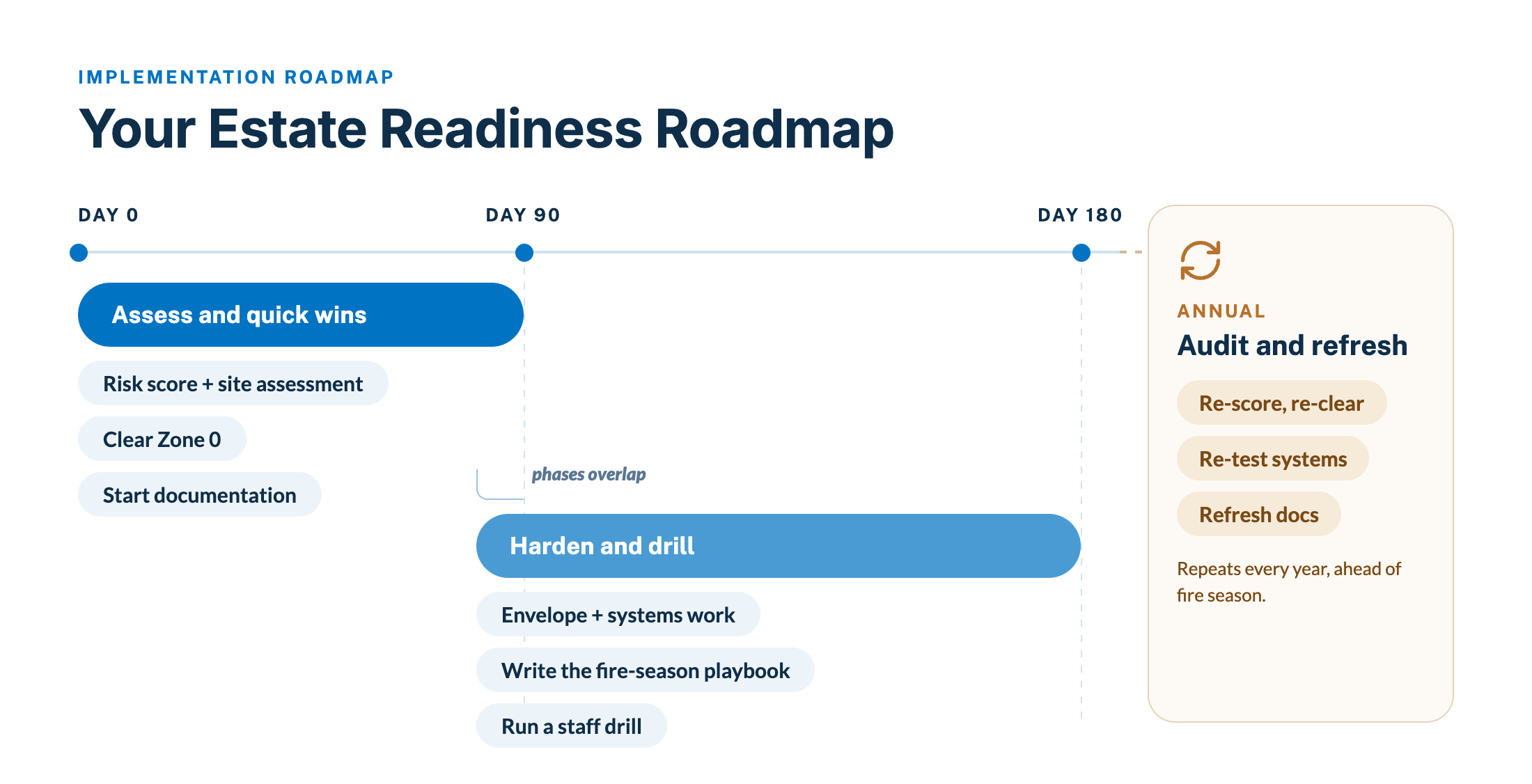
Here's the order to do it in so you're covered before next season. The framework tells you what the layers are; this tells you when to do each one.
Days 0 to 90: assess and quick wins
Pull your address-level risk score and the regional data, then book a professional site assessment. While you wait, take the free wins: clear the first 5 feet around every structure, screen or upgrade vents, clean gutters and roofs, and move firewood and combustibles away from walls. Start the documentation file the same week. By day 90 you should know your real risk and have removed the easy ignition points.
Days 90 to 180: harden and drill
Schedule the bigger envelope work from the assessment: roofing, windows, and siding upgrades, plus any active systems that make sense for your access and water situation. Write the fire-season playbook, assign roles, and run one drill with family and staff so the plan is muscle memory before a red-flag day, not a document nobody's read. If an on-site refuge belongs in your plan, this is the window to evaluate and specify it.
Run an annual audit
Once the program exists, it needs a yearly pass. Re-check the risk score, re-clear the zones, re-test the systems, refresh the documentation, and re-run the drill. Wildfire risk management holds up only when it's maintained, the same as any other system on the property.
Where the FORT Fits
Within the on-site refuge layer, the FORT is a purpose-built option engineered specifically for wildfire conditions. It's an above-ground structure designed to work alongside evacuation planning, home hardening, and defensible space, not to replace any of them. Evacuation stays the first move; the FORT is there for the case where that move isn't available.
What sets it apart is the engineering behind it. Wildfire Safety Systems was founded by people from Strata Products Worldwide, a company with decades in underground mine-refuge and life-support technology, and the FORT brings that lineage to wildfire. It's built with fire-resistant construction, a sealed structure to limit smoke and gas intrusion, and an integrated breathable-air system based on refuge-chamber standards. It also holds third-party evaluation through IAPMO Uniform Evaluation Service.
The testing is specific and worth reading directly:
- Fire-resistance testing to ASTM E119 and CAN/ULC S101, which expose construction to sustained temperatures up to 2000°F, hotter and longer than typical wildfire exposure
- Live human-subject air-system testing that held safe oxygen and carbon dioxide levels for up to 8 occupants over a 4-hour duration
You can review the full testing program and protocols on the WSS safety and testing page.
For an estate, that combination addresses the exact scenario the risk assessment flagged: a property where the exit can fail and people need a protected space that's engineered, tested, and ready.
Explore the FORT
Frequently Asked Questions
Wildfire risk management is the ongoing process of measuring a property's wildfire exposure and reducing it through layered controls, seasonal operations, and financial planning. For a large or high-value property, it works as a year-round program across 5 layers: assessing exposure, hardening the buildings and grounds, operating through fire season, planning for on-site refuge, and documenting the work for insurance.
In California, the fastest free address-level lookup is CAL FIRE's Fire Hazard Severity Zone viewer, where you type a full street address and get a hazard rating of Moderate, High, or Very High for that parcel. Outside California, state forestry agencies and regional wildfire risk explorers offer similar address or community searches. First Street's Risk Factor tool, which many articles still cite, no longer offers a free public address lookup. Treat any map rating as a starting point and follow it with an on-site assessment, which is the only way to account for your slope, vegetation, and access.
FEMA retired the standalone National Risk Index map in December 2025 and moved the wildfire data into its Resilience Analysis and Planning Tool, a mapping application built for emergency planners. The ratings are accurate for what they measure, which is relative wildfire risk at the county level. They aren't precise enough to judge a single property, because a county rating can't account for one parcel's slope, vegetation, or defensible space.
Wildfire mitigation can lower premiums and improve your chances of keeping coverage, particularly in California. The state's Safer from Wildfires framework requires admitted insurers to credit specific actions, such as a Class A roof, ember-resistant vents, and clearing the first 5 feet around the home. Documenting the work with photos, receipts, and inspection records is what turns mitigation into insurance value.
Evacuation is always the safest option, and the goal is always to leave early. For the case where evacuation becomes impossible, an on-site refuge engineered for wildfire can provide a protected space with heat resistance and a breathable-air system. The FORT is one such option, an above-ground, tested refuge designed to work as one layer of a broader plan that still prioritizes evacuation. Storm shelters and security safe rooms are built for other threats and aren't designed for wildfire heat and smoke.
Key Takeaways
- Wildfire risk management is a year-round program, not a one-time purchase
- Measure first: an address-level score plus a site assessment beats guessing
- Hardening the envelope and grounds is the highest-impact layer
- Fire season needs a written playbook and named roles, not improvisation
- On-site refuge is a planned contingency for when evacuation fails, never a replacement for leaving early
- Documented mitigation earns insurance credit and speeds claims
- Sequence the work over 90 to 180 days so you're ready before the next season
Final Thoughts
A luxury estate can carry more wildfire protection than almost any other property, but only if the protection is run as a system rather than assembled as a collection of purchases. The estates that come through a bad fire season well are the ones that measured their risk, hardened in the right order, drilled their staff, and wrote down who does what when the smoke arrives.
Evacuation is and stays the first plan. When you've built the layers underneath it, an on-site refuge like the FORT becomes the last piece that makes the whole plan hold, the protected space for the one scenario the other layers can't cover.