Table of Contents
- What Counts as a Wildfire Safety Bunker
- What You'll Actually Pay
- Accreditation and Standards
- How to Choose: A Decision Framework
- What Performance Actually Means
- Types Compared: Above-Ground, Underground, and Safe Room
- Siting, Access, and Aesthetics
- Installation Roadmap
- Operations: Drills, Maintenance, and Documentation
- The FORT: Purpose-Built for These Conditions
- Frequently Asked Questions
- Key Takeaways
- Final Thoughts
Most homeowners in wildfire country spend real time thinking about defensible space, home hardening, and evacuation routes. Those are the right priorities. Get them right and the odds of your home surviving a fire, and you surviving with it, improve substantially.
But there's a subset of homeowners who reach the end of that planning process and still feel like something is missing. They've cleared the brush, replaced the vents, and mapped 2 evacuation routes. And they're still asking: what happens if I can't get out? That's where on-site refuges enter the picture. More specifically, wildfire safety bunkers.
This guide is for homeowners who are past the basics and actively evaluating whether a purpose-built refuge structure belongs on their property. It covers what these structures actually are, what separates a well-engineered bunker from a poorly designed one, what you'll realistically spend, and how to make the decision given your lot, family, and risk profile. Evacuation is always the priority. Local authority instructions come first, always. A refuge structure is a planned component of a layered safety strategy, not a reason to stay behind.
In Short
Wildfire safety bunkers are purpose-built structures designed to protect occupants during a wildfire burnover event. They range from above-ground modular units to underground chambers to reinforced safe rooms, and they vary significantly in how well they actually perform under fire conditions. The decision to buy one involves more than price: construction standards, independent testing, air management systems, and site conditions all affect whether a structure performs when it matters.
The FORT®, built by Wildfire Safety Systems, is an above-ground refuge engineered specifically for wildfire conditions, with a managed air system and fire-resistant construction designed to integrate into a broader wildfire safety plan alongside evacuation planning and home hardening.
What Counts as a Wildfire Safety Bunker
The term "wildfire safety bunker" gets applied to a surprisingly wide range of products. Some deserve the label. Others don't.
At the most basic level, a wildfire safety bunker is a structure designed to protect its occupants during a burnover: the event where a wildfire moves through a location and briefly subjects it to extreme heat, flame, and radiant energy. The structure's job is to maintain a survivable interior environment for the duration of that event. That's a specific engineering challenge. The structure needs to resist heat transfer through walls, doors, and any penetrations. It needs to maintain breathable air as exterior oxygen levels drop and CO and CO2 levels rise outside. It needs to provide reliable egress once conditions have improved.
What it is not: a storm shelter (designed for debris impact), a security safe room (designed for human threats), or a general emergency shelter (designed for extended habitation). All 3 of those exist and are sold to homeowners. None of them are designed for wildfire burnover conditions. A fireproof safe room can provide some protection in a wildfire scenario, but only if it's been engineered with the right air management and sealing — a distinction that matters enormously and one that most marketed safe rooms don't address.
Use cases vary. A property owner with limited evacuation options may prioritize the refuge structure as a planned fallback within a broader strategy. An estate owner may use it to protect family members and staff while also securing irreplaceable valuables before evacuating. In each case, the structure is part of a plan, not a substitute for one.
Read about what wildfire safe rooms can and cannot do
What You'll Actually Pay: Unit Cost, Site Work, and Total Ownership
Cost discussions around wildfire safety bunkers tend to focus on the unit price. That number is real but incomplete. The total cost of ownership includes site preparation, utilities, communications service, ongoing maintenance, and periodic recertification.
Unit cost for a purpose-built above-ground wildfire refuge runs from roughly $30,000 on the low end to well over $100,000 for larger, fully equipped configurations. Underground units, which require excavation and drainage engineering, typically run higher once installed. Converted safe rooms within existing structures vary widely depending on what modifications are needed.
Site work adds meaningful cost. A cleared perimeter (minimum 30 feet of fuel removal), proper berming around the base of an above-ground unit, and a level pad are baseline requirements. If the chosen location requires grading or utility trenching, costs rise accordingly.
Power and air systems are not optional. A refuge structure without a managed air supply traps occupants in rising heat instead of protecting them from it. The breathing air cylinders, pressure relief valves, and backup power supplies that keep a structure survivable all require installation, connection to power, and scheduled maintenance.
Communications capability belongs in the budget too. A refuge that can't reach the outside world leaves occupants unable to call for help, confirm their status, or know when conditions outside have cleared. Equipment like a cell signal booster and a Wi-Fi access point keeps phones and devices working inside a sealed structure, and that capability depends on an active cellular or internet service, so it carries an ongoing cost, not just a one-time install.
Ongoing costs include semi-annual inspections by a certified technician, cylinder recharging after any use, and replacement of consumables (water, food bars, batteries, first aid supplies). A maintenance contract removes the burden of tracking these cycles and ensures the structure is ready when it's needed.
Accreditation and Standards: What Independent Testing to Look For
This is where most buyers get lost. Refuge structures for homeowners sit in a regulatory gap: there's no single federal standard that governs wildfire-specific residential bunkers the way there are standards for coal mine refuge chambers or FEMA-rated storm shelters. But meaningful benchmarks do exist, and knowing how to read them separates a credible product from one riding marketing language.
NIOSH and CFR 30 Part 7
These standards govern refuge alternative chambers for underground mining operations. They cover oxygen levels (maintained between 18.5 and 23 percent), CO2 concentrations (average 1.0 percent or less, with excursions not exceeding 2.5 percent), structural integrity, and duration requirements. The 96-hour duration standard for mining refuge chambers is a significantly more demanding benchmark than the 4-hour window relevant to wildfire burnover. Manufacturers who reference these standards are using a rigorous baseline — one developed specifically for life-safety scenarios where survivable air is the primary variable.
UL Fire Ratings
UL fire ratings apply to individual components, including fire doors, hardware, and seals. These ratings reflect tested performance at specific temperatures and durations. They don't govern an entire structure, but they give you a point of comparison for components. A UL-rated fire door with a tested seal is a different product than a steel door with no independent rating.
Third-Party Testing
The most relevant question to ask any manufacturer: has the complete structure, not just its components, been tested under realistic wildfire exposure conditions? What were the test parameters? What were the results? Manufacturers who have done this testing should be able to share documentation. Avoid products that cite component ratings without demonstrating how the complete system performs, use "fireproof" language without specifying temperature and duration, or carry no independent test data at all. You can review the FORT's safety testing documentation as a reference point for what that transparency looks like in practice.
How to Choose a Fire Safety Bunker: A Decision Framework
No single configuration is right for every property. The right choice depends on your lot, your household, and your risk profile.
Lot and Siting Constraints
An above-ground unit requires a cleared perimeter and a stable base. If your lot is small, has significant grade changes, or is subject to HOA restrictions on accessory structures, your options narrow. An underground unit requires good drainage and soil conditions that support excavation. High groundwater tables, expansive soils, or bedrock close to the surface create engineering complications that raise cost and risk considerably. For a deeper look at the site-specific challenges involved in going below grade, the underground fire shelter guide walks through what those installations actually involve.
- Above-ground units require a cleared perimeter, stable base, and level pad
- Small lots, significant grade changes, and HOA restrictions can all limit your options
- Underground units require good drainage and excavation-compatible soil conditions
- High groundwater tables, expansive soils, or bedrock close to the surface create engineering complications that raise cost and risk considerably
Household Profile
How many people need to shelter? Are there family members with mobility limitations? How quickly can your household reach the structure under stress? A refuge structure that takes 10 minutes to load and activate is less useful during a fast-moving fire than one that can be entered and sealed in 2 minutes. Drills with your actual household, under timed conditions, are not optional.
- Confirm the unit's capacity covers your full household
- Account for family members with mobility limitations — both access speed and entry method matter
- Time how long it takes your household to reach and enter the structure under realistic conditions
- A structure that takes 10 minutes to load and activate is far less useful than one sealed in 2
Risk Profile
Properties on steep slopes with poor road access and long evacuation windows face a different risk profile than properties on flat land with 2 paved exits. The higher your probability of a blocked evacuation, the more defensible the decision to invest in an on-site refuge. Your wildfire risk score is a useful starting point for understanding your exposure.
- Steep slopes, single-road access, and long evacuation windows all increase the case for an on-site refuge
- Properties with 2 or more clear paved exits face a meaningfully different risk profile
- Check your wildfire risk score by address as a starting point for understanding your exposure
- The higher your probability of a blocked evacuation, the more this layer of your plan matters
Budget
Budget shapes what's possible, but it shouldn't determine what's acceptable. A low-cost structure that can't manage its interior air supply creates false confidence. That's a worse outcome than no structure at all.
- Set a realistic total budget that accounts for site work, utilities, and ongoing maintenance — not just the unit price
- A low-cost structure with no engineered air supply creates false confidence
- That's a worse outcome than no structure at all — prioritize air system quality and tested construction over size or features
Wildfire Planning
Do you need an on-site refuge?
Fire Safety Bunker Standards: What Performance Actually Means
Performance for a wildfire refuge structure comes down to 4 things: heat management, air supply, structural integrity, and egress.
Heat management starts with the walls. Concrete and reinforced composite panels perform better than metal alone because metal conducts heat rapidly. The insulating core matters. So do the door assemblies: a UL-rated fire door with a proper seal and fire-resistant hardware is a different product than a steel door with no rating. Radiant heat, not just direct flame, is often the primary exposure during a burnover, and the wall assembly needs to account for both. This is one of the consistent limitations of converted interior safe rooms — they're typically designed around structural integrity, not radiant heat transfer or air management.
Air supply is the non-negotiable element. During a burnover, ambient oxygen drops as the fire consumes it. CO levels outside can become lethal within minutes. A properly engineered air system maintains positive pressure inside the structure, keeps oxygen in the survivable range, and prevents CO intrusion. It also provides a modest cooling effect by moving fresh air through the space. Cylinder capacity determines how long the system can operate. Duration claims should always be tied to occupancy counts: a 4-hour supply for 2 people is a different product than a 4-hour supply for 8.
Structural integrity covers the wall assembly, door frame, and base connection. The structure needs to remain intact through a burnover and keep door seals functional throughout. A warped door frame is an air leak. An unsealed base is a ground-level intrusion point for heat and gases.
Egress is often overlooked. Getting out after the fire passes is as important as staying protected while it burns. A secondary escape hatch provides a redundant exit if the primary door is blocked by debris. Check that egress routes are designed and accessible under stress.
Types Compared: Above-Ground, Underground, and Safe Room
The 3 main categories of wildfire refuge structures each have genuine trade-offs. Understanding them helps you evaluate what you're actually buying rather than what a product's marketing implies.
Above-ground units offer the clearest advantages in most residential situations. They're faster to access during an emergency, easier for a certified technician to inspect and maintain, and free of the groundwater, drainage, and excavation complications that affect underground options. Properly engineered above-ground units with fire-resistant construction and managed air systems are the most purpose-built option for wildfire-specific conditions.
Underground units have real appeal for homeowners concerned about radiant heat exposure, since burial provides some thermal mass. The trade-offs are meaningful. Drainage and groundwater management add installation complexity. Access requires descending into a structure, which creates challenges for household members with mobility limitations and slows entry under stress. Post-fire debris can block the access hatch. The full picture on what underground installation and maintenance actually involves is worth reading before this option goes far in your evaluation — the real costs and site-specific risks are frequently underestimated.
Converted safe rooms within existing structures are the most variable category. A well-engineered room with fire-rated walls, a UL-rated door, and a managed air system can provide meaningful protection. A room that's been called a "safe room" because it has a solid door and no windows provides almost none. There's a further catch that surprises a lot of homeowners: many products marketed as "fireproof," including UL-rated safes and safe rooms, aren't rated for the sustained temperatures a structure fire can reach, which can run far hotter and far longer than those ratings assume. A UL rating tells you a component passed a specific test, not that it will hold up through a prolonged burn. The reasons fireproof safes fall short in wildfire conditions are worth understanding before relying on one. The key question for any safe room is whether it has an engineered air supply, or whether it relies on whatever air is present when the doors are sealed.
| Feature | Above-Ground (Purpose-Built) | Underground | Converted Safe Room |
|---|---|---|---|
| Access speed | Fast | Moderate (descent required) | Depends on location in home |
| Heat management | Engineered wall assembly | Thermal mass from soil | Variable by construction |
| Air system | Standard in purpose-built units | Varies; required for safe use | Rarely included |
| Water intrusion risk | Low | Moderate to high depending on site | Low |
| Maintenance access | Easy | Requires descent | Easy |
| Installation complexity | Moderate | High | Low to moderate |
| Estimated cost range | $30K–$100K+ | $50K–$150K+ installed | Wide range |
| Post-fire egress | Primary door + escape hatch | Potential for blocked hatch | Standard door |
Siting, Access, and Aesthetics
Where you place a refuge structure affects both its performance and its practical usability. A structure positioned 200 feet from the house in a remote corner of the property may have excellent clearance but be unreachable during the final minutes before a burnover. Proximity matters more than any other siting variable: can your household reach the structure in 2 minutes or less from the main living areas?
Beyond proximity, the approach path should be clear of obstacles that could trap people or vehicles, and a minimum 30-foot radius of cleared, non-combustible material around the unit is a non-negotiable operating requirement. That fuel clearance affects not just performance during a fire event but also ongoing warranty and inspection compliance.
For estate properties, historic properties, and high-value residential properties with HOA restrictions, aesthetics are a legitimate concern. Purpose-built above-ground units can be placed to minimize visual impact, bermed with graded earth, or screened with non-combustible hardscape. Gravel, concrete, and stone can all be used effectively. Combustible plantings can't — the 30-foot clearance requirement takes precedence. For homeowners who've already invested in building a fireproof house with attention to aesthetics and materials, the same approach to thoughtful site integration applies to a refuge structure.
Rescue visibility matters too. A structure that's easy to find from the road or air, with a clear approach, helps emergency responders reach occupants after a burnover has passed. Some jurisdictions can go further: with the owner's permission, a refuge's location, occupancy status, and entry details can be added to the mapping systems first responders use in the field, so crews know the structure is there, whether anyone is inside, and how to get them out.
learn more about building a fireproof house
Installation Roadmap: Delivery Through Commissioning
The installation process for a purpose-built above-ground refuge structure follows a predictable sequence, but each step has practical requirements that are easy to underestimate if you haven't done it before.
Site preparation comes first. The pad needs to be graded, leveled, and capable of bearing the structure's weight. Utility connections, including AC power for communications equipment and backup power supplies, need to be roughed in before the unit arrives. Address any access constraints — narrow driveways, low-clearance gates, steep grades — well before scheduling delivery, since these can affect what equipment is needed onsite.
Delivery for a modular above-ground unit requires equipment access: a delivery vehicle and potentially a crane or telehandler depending on site conditions. Coordinate delivery logistics with your representative in advance.
Berming around the base of the structure is a post-delivery requirement for above-ground units. Soil, fine gravel, or sand should cover the steel frame perimeter so no exposed metal is visible at grade. This limits heat transfer through the base connection and is a condition of ongoing warranty compliance.
Commissioning involves a certified technician confirming that all air cylinders are full and functioning, the pressure relief valve operates correctly, all communications systems are connected and powered, backup power supplies are charged, and the interior kit is fully stocked.
Documentation at delivery includes the limited warranty, arbitration and indemnification agreements, and customer acceptance agreement. The User Instructions are posted inside the structure and acknowledged in writing during purchase. All of this should be stored accessibly, including digitally in your accoun
First inspection must be scheduled within 6 months of delivery. Missing this window voids the limited warranty. Subsequent semi-annual inspections are required to maintain certification and ensure the structure is ready to perform.
Operations: Drills, Maintenance, and Documentation
A refuge structure that's never been practiced with is a refuge structure that will be used incorrectly under stress. Drills aren't optional — they're what converts an installed piece of equipment into a functional part of your safety plan.
A realistic drill covers the complete sequence: receiving an alert via Watch Duty or a county emergency notification, gathering household members, loading optional equipment and valuables, entering the structure, closing and sealing both doors, confirming all air cylinders are open, and communicating your status to an outside contact. Time it. Run it with every household member present, including children and anyone with mobility limitations. The drill should take less time than your realistic warning window.
Maintenance schedules align with inspection cycles. Every 6 months, a certified technician confirms cylinder charge levels, pressure relief valve function, fuel clearance compliance, backup power status, and consumable inventory. Any use of the air cylinders outside an emergency, even briefly, triggers a required inspection to recharge and recertify the unit.
For insurance and HOA purposes, maintain a documented maintenance log including inspection dates, technician certifications, and any condition findings. Some insurers require documentation of on-site safety features to adjust coverage terms. Some HOAs require permit documentation for accessory structures. Both are easier to address before installation than after.
The FORT®: Purpose-Built for These Conditions
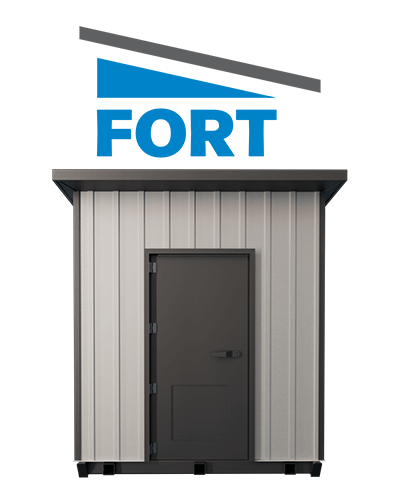 Wildfire Safety Systems developed the FORT® specifically for wildfire burnover scenarios, drawing on engineering experience from refuge chambers built for the mining and tunneling industries, where occupant survival under extreme conditions is the design baseline.
The FORT's construction uses EVG-3D modular panels coated with flame-resistant precast concrete. Its air system maintains oxygen between 18.5 and 23 percent and holds CO2 at 1.0 percent average or less, referencing the same NIOSH and CFR 30 Part 7 standards that govern 96-hour mining refuge chambers. The standard unit accommodates up to 8 people with 4 hours of breathing air, 2 fire-rated door assemblies, a secondary escape hatch, cell signal booster, Wi-Fi access point, and a full interior kit.
It's an above-ground structure by design. Faster access, simpler maintenance, no groundwater risk, and siting flexibility are all intentional advantages. The FORT® is designed to fit into a layered wildfire safety plan, complementing evacuation planning and home hardening rather than substituting for either.
Frequently Asked Questions
Storm shelters are designed to protect occupants from wind-driven debris and structural collapse. They're built around impact resistance, not heat resistance, and they don't include managed air systems to address smoke, CO intrusion, or oxygen depletion. A shelter that performs well in a tornado may provide very little protection in a wildfire burnover, particularly if it lacks a sealed air supply. If you're evaluating a shelter specifically for wildfire, the air system and heat-resistant construction are the variables that matter most.
Most burnover events involve 10 to 30 minutes of peak exposure, though smoldering and elevated temperatures can persist for hours afterward. The FORT's 4-hour air supply is designed to cover both the burnover event and the post-fire period when conditions outside may still be dangerous. That buffer gives occupants time to assess whether it's safe to exit without rushing the decision.
The soil surrounding an underground bunker provides thermal mass, which can reduce peak interior temperature. But burial alone doesn't create a survivable environment — you still need an engineered air supply to address oxygen depletion and CO intrusion. Underground units also introduce drainage and groundwater risks, access challenges, and maintenance complications that purpose-built above-ground structures avoid. Performance depends on how well the unit was engineered, not simply on the fact that it's buried.
HOA regulations vary significantly. Some treat above-ground refuge structures as accessory structures requiring approval; others have specific provisions for safety equipment. Above-ground units can often be sited and screened to minimize visual impact. The most productive approach is to request the HOA's accessory structure approval process before purchase and have installation documentation ready for review.
After any activation where the air cylinders are turned on, the unit must be inspected and recertified by a Wildfire Safety Systems technician before it's ready for use again. Cylinders need to be recharged, consumables restocked, and all systems confirmed operational. Contact Wildfire Safety Systems customer service immediately after exiting the structure.
Key Takeaways
- "Wildfire safety bunker" covers a wide range of products — heat management, engineered air supply, structural integrity, and egress are what actually determine performance
- Total cost of ownership includes site work, utility connections, and semi-annual maintenance, not just the unit price
- No federal residential bunker standard exists; look for NIOSH/CFR 30 Part 7 air benchmarks and third-party structural test data
- Above-ground purpose-built units offer faster access, simpler maintenance, and no groundwater risk compared to underground alternatives
- Converted safe rooms vary from genuinely protective to effectively inert — the difference is an engineered air supply
- Siting within 2 minutes of the main structure is a practical requirement; 30-foot fuel clearance around the unit is non-negotiable
- Drills with every household member, timed, are required for the structure to function as intended under real conditions
- Documentation for insurance, HOA, and warranty maintenance should be current from day one
Final Thoughts
A wildfire safety bunker is a significant decision: financially, logistically, and in terms of how it fits into your household's overall wildfire plan. The technology works when it's engineered correctly, installed properly, maintained consistently, and practiced with. The variables that matter most aren't the ones that show up in marketing materials — they're the air system specs, the door ratings, the inspection requirements, and whether your household can reach the structure and use it correctly under stress.
If you're at the point in your wildfire planning where an on-site refuge makes sense, the next step is getting a clear picture of what a specific unit would require on your specific property. Configuration, siting, and site preparation all have real-world implications that a general guide can only take so far. The 3 preceding guides in this cluster — on fireproof safe rooms, building a fireproof home, and underground fire shelters — are useful context before those conversations get specific.
Discover the FORT®