
Table of Contents
- What Is a Wildfire? Definition and Quick Facts
- What Causes Wildfires: Human vs Natural
- How Often Do Wildfires Happen?
- How Long Do Wildfires Last?
- What to Do Before and During a Wildfire
- How to Explain Wildfire Facts to Kids
- Where the FORT Fits in a Layered Wildfire Plan
- Frequently Asked Questions
- Key Takeaways
Search "wildfire facts" and you'll find solid data, outdated statistics and a few myths, often on the same page. Your safety plan should rest on the accurate numbers.
This guide collects the reliable wildfire facts in one place. It covers what starts most wildfires, how often they happen, why some burn for a day and others for months, and what to do before one reaches your road. It's written for homeowners who live in or near wildfire country. It also works as a plain-language reference for explaining wildfire to kids.
Evacuation is the safest thing you can do when a wildfire threatens. Leave early, on the first warning. Every step in this guide supports that decision.
In Short
People start close to 85% of U.S. wildfires. Lightning starts most of the rest. The U.S. recorded 64,897 wildfires in 2024, and the yearly count stays in the tens of thousands. Most wildfires are controlled within a day. Large fires in steep or remote terrain can burn for months. Preparing ahead and leaving early are the steps that protect a household.
Evacuation is always the safest option. Leave early every time. If evacuation becomes impossible, the FORT® is an on-site refuge option within a broader preparedness strategy, designed to work alongside evacuation planning and home hardening.
What Is a Wildfire? Definition and Quick Facts
A wildfire is any unplanned, uncontrolled fire burning in vegetation such as forest, grassland or brush, including the areas where that vegetation meets homes. The term covers a 2-acre grass fire that crews put out in an hour. It also covers a 900,000-acre forest fire that burns for 3 months.
A prescribed burn is a fire that agencies set on purpose, under a written plan, to reduce fuel. Crews manage it from start to finish. Agencies usually announce prescribed burns ahead of time, so your local fire agency's website or social feed can tell you whether nearby smoke is planned.
The key numbers from 2024, each covered in more detail below:

What Causes Wildfires: Human vs Natural
People start close to 85% of wildfires in the United States, according to the National Park Service. Lightning starts most of the rest. Because most wildfires start with human activity, most of them can be prevented.
Most human-caused wildfires start during everyday activity. Common sources include equipment and vehicle sparks, power lines damaged or downed in high wind, debris and yard burning that escapes, unattended campfires and fireworks. A trailer safety chain dragging on dry pavement can throw sparks into roadside grass. So can a lawnmower blade striking a rock on a hot afternoon.
Human-caused fires also stretch the fire season. A 2017 study in the Proceedings of the National Academy of Sciences reviewed 1.5 million U.S. wildfire records from 1992 to 2012. People started 84% of those fires, and their ignitions tripled the length of the fire season. People start fires in spring, fall and winter, months when lightning is rare. Many human-caused fires also start along roads and near homes, so they can threaten structures from the first minute.
Lightning is the main natural cause. It starts fewer fires than people do, yet lightning fires burn a large share of the acreage in remote Western forests. They often ignite in backcountry that crews can't reach quickly, so they have more time to grow. Volcanic activity starts a very small number of fires in a few regions.
Common wildfire myths and the facts behind them:
- "Most wildfires are natural." People start close to 85% of U.S. wildfires.
- "A contained fire is out." A contained fire has a completed fuel break around its perimeter. It can keep burning inside that line for weeks.
- "Wildfires are a forest problem." The fires that destroy the most homes burn in the wildland-urban interface, where neighborhoods meet vegetation.
Our guide to how wildfires start covers each ignition source in detail, including how a single spark grows into a fast-moving fire. For more background, see our guides on what causes wildfires and how forest fires start.
How Do Wildfires Start
How Often Do Wildfires Happen?
The U.S. records tens of thousands of wildfires every year. In 2024, 64,897 fires burned about 8.9 million acres, according to the National Interagency Fire Center. The yearly total rises and falls, and it stays in the tens of thousands.
California accounts for a large share. In 2024 the state recorded 8,316 wildfires and 1,081,144 acres burned, close to 13% of the national fire count. Long dry summers, steep terrain and seasonal winds such as the Diablo and Santa Ana winds keep California near the top most years. The Southeast and the Great Basin also record high numbers.
Fire season in California runs longer than it did a few decades ago, and CAL FIRE now treats parts of the state as having year-round fire risk. Most large California fires still burn between June and November. The fall wind season brings many of the most destructive ones, because dry offshore winds push fire toward neighborhoods at high speed.
Worldwide, most of the area that burns each year is grassland and savanna. Africa accounts for the largest single share. Forest fires get more news coverage and burn less total area.
National averages say little about a single property. Your local fire history, vegetation and slope tell you more. Our guide to how often wildfires occur breaks the numbers down by state and region, and it lists free tools for checking the wildfire risk in your area.
How Often Do Wildfires Occur
How Long Do Wildfires Last?
Most wildfires are controlled within a day of ignition. Crews catch the large majority while they're still small. Wildfires that burn for weeks or months make up a small fraction of total ignitions. They usually involve heavy fuel, steep or remote terrain, and weather that keeps pushing the fire.
The percentage in news reports refers to containment. Containment shows how much of the fire's perimeter has a completed fuel break around it. The fire can keep burning inside that perimeter for weeks, in pockets you may not see from the road. Fire agencies track 3 milestones, defined in the InciWeb terminology glossary:
| Status | What it means | What's still burning | What it means for you |
|---|---|---|---|
| Contained | A fuel break is complete around the perimeter | Anything inside the line | The fire is unlikely to grow. It is still active, and evacuation orders may stay in place |
| Controlled | The fire and any spot fires are extinguished, and the fireline is strengthened | Smoldering material may remain; flare-ups can't cross the line | Closures start lifting, and crews shift to mop-up and repair |
| Out | No burning or smoldering material remains | Nothing | The incident is over |
California's largest fires show how long this can take. The August Complex in 2020 took 88 days to reach full containment. The Dixie Fire in 2021 took 104. Weeks or months can pass between 100% containment and the day a fire is declared out. On fires that size, fall rain usually puts out the last of the fire.
After containment, crews start mop-up. They put out burning material along and near the control line, cut down burning snags and move logs so they won't roll downhill. On a large fire, mop-up can take weeks. Smoke may stay visible during that time from fuel still burning inside the line.
Our guide to how long wildfires last covers what keeps a fire burning for months and how to track an active fire near you.
How Long Do Wildfires Last
What to Do Before and During a Wildfire
Leaving early is the most protective decision you can make. Everything you do beforehand makes that decision faster and easier when a warning comes. Good preparation shortens the time between the first alert and your family driving away safely.
Before fire season, work through these 6 steps:
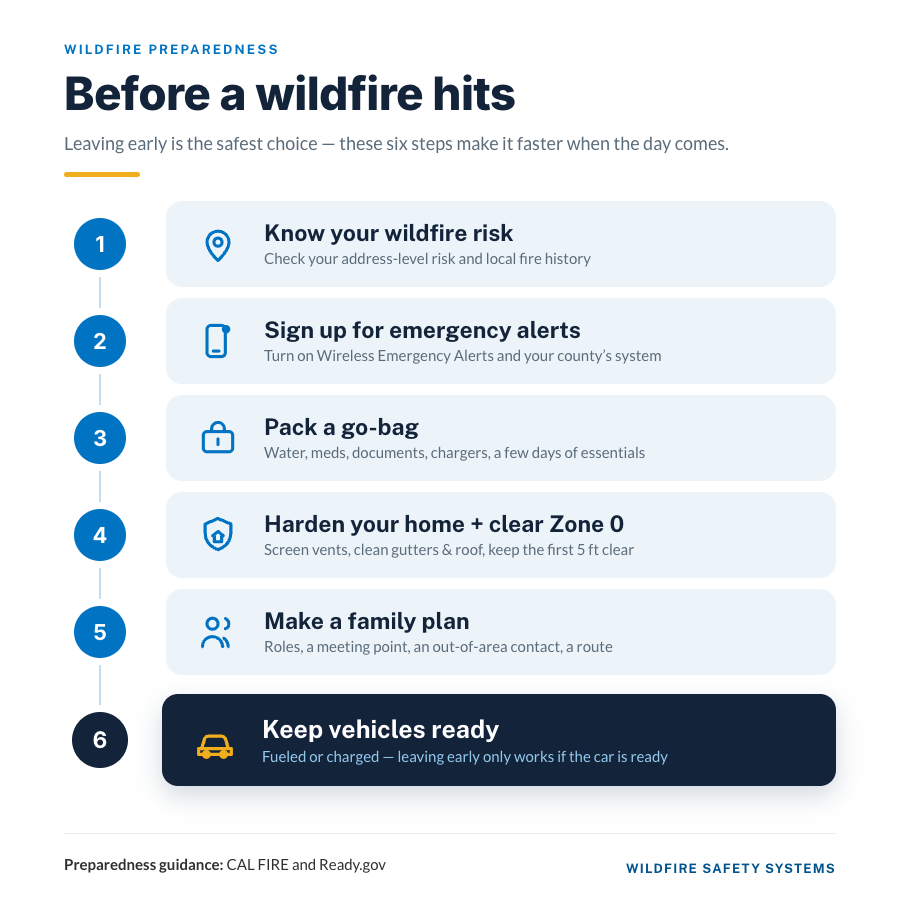
- Know your risk. Check your property's wildfire hazard rating and your area's fire history before fire season starts.
- Turn on alerts. Enable Wireless Emergency Alerts on your phone and sign up for your county's emergency notification system. Know which official sources report fires in your area.
- Pack a go-bag. Include water, medications, documents, chargers and a few days of essentials, and keep it by the door. Use our go-bag packing list, or our emergency preparedness kit guide if you're starting from scratch.
- Harden the home and clear Zone 0. Screen vents, clean gutters and roofs, and keep the first 5 feet around the house clear of anything that burns. Wind-blown embers cause most home ignitions during wildfires, and a clear Zone 0 leaves them nothing to ignite next to the walls.
- Make a family plan. Set roles, a meeting point, an out-of-area contact and a route everyone knows. Our step-by-step wildfire preparation guide walks through it.
- Keep vehicles fueled or charged. Park facing the road during fire season so you can pull out quickly.
When a Wildfire Is Active
California uses 2 levels of evacuation notice. An evacuation warning means a threat to life and property is possible. It's the right time to leave early, and the time to go if you have pets, livestock or family members who need extra time. An evacuation order means the threat is immediate and you must leave now.
Get fire updates from official sources, such as your county emergency alerts and your local fire agency. Leave as soon as an evacuation warning or order is issued. If you have a written evacuation checklist, work through it. A fast-moving fire can close routes with little notice, and households that wait to see what the fire does lose time they may need on the road. Leaving early is always safer than staying.
Our wildfire preparedness hub brings all of these steps together in one place.
How to Explain Wildfire Facts to Kids
Kids handle wildfire information best when it comes with a family plan. Start with what your family will do if a fire comes, then share the facts. A child who has practiced the plan knows what to do and has less to worry about.
- Keep the facts simple and true. For a young child, 3 facts are enough. Fire needs dry plants to burn, so we clear the yard. Most fires are started by people, so we're careful with fire. Grown-ups practice leaving quickly, the same way you practice a fire drill at school.
- Practice the plan together. Show them the go-bag and let them pack a small one of their own. Walk to the meeting spot. Tell them who the out-of-area contact is. Practice calmly on an ordinary afternoon, so the steps feel familiar if a real warning comes.
Where the FORT Fits in a Layered Wildfire Plan
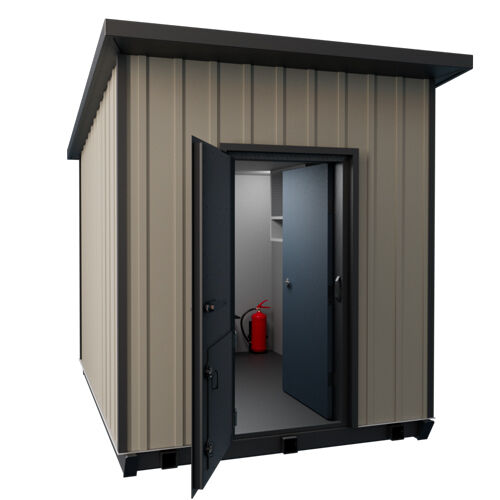
A layered wildfire plan starts with evacuation. Home hardening and defensible space come next, and they lower the chance that your house ignites. An on-site refuge adds a layer for the situation where a fire moves faster than the roads allow and leaving is no longer possible.
The FORT is an above-ground refuge engineered for wildfire-specific conditions. It has heat-resistant construction and a managed air system, and it's designed for family use. It works as one layer of a broader wildfire protection plan, alongside evacuation planning and home hardening. When a warning is issued, you still leave.
That layer matters most on properties with a single access road and in areas where large fires stay active for weeks. The FORT is tested to withstand up to 2,000°F burnover conditions, and the full test record is on the safety and testing page.
Ahead of fire season, store what you can't replace in the FORT: passports, insurance records, family photos, and hard drives. If the house burns, those items are protected inside it. With them already stored, you have less to gather when an evacuation order comes.
Frequently Asked Questions
A wildfire is an unplanned, uncontrolled fire burning in vegetation such as forest, grassland or brush, including the wildland-urban interface where that vegetation meets homes. A prescribed burn is a fire that agencies set on purpose and manage to reduce fuel. Wildfires range from a few acres to hundreds of thousands of acres.
People cause close to 85% of wildfires in the United States, according to the National Park Service, and lightning causes most of the rest. Common human sources include equipment and vehicle sparks, power lines, escaped debris burning, unattended campfires and fireworks. Most human-caused fires can be prevented. Our guide to how wildfires start covers each source.
The United States records tens of thousands of wildfires every year. In 2024, 64,897 wildfires burned about 8.9 million acres, per National Interagency Fire Center data. California recorded 8,316 of those fires, close to 13% of the national count. Our guide to how often wildfires occur breaks the numbers down by state and region.
Most wildfires are controlled within 24 hours of ignition, because crews catch most fires while they're still small. Large fires in steep or remote terrain can burn for weeks or months. The Dixie Fire took 104 days to reach full containment in 2021. A fire can be 100% contained and still burn inside its perimeter for weeks before it is declared out. Our guide to how long wildfires last explains what keeps large fires burning.
An on-site wildfire shelter is designed to work alongside evacuation, which is always the safest option and the first step in every wildfire plan. A shelter is for the situation where a fire moves faster than the roads allow and leaving is no longer possible. The FORT is one such option: an above-ground, tested refuge with heat-resistant construction and a managed air system, built as one part of a layered wildfire protection plan.
Key Takeaways
- People start close to 85% of U.S. wildfires, so most can be prevented.
- The U.S. recorded 64,897 wildfires in 2024 across about 8.9 million acres.
- Most wildfires are controlled within a day. Large fires can burn for months.
- Containment measures the secured perimeter. A contained fire can still burn inside it.
- A fire is out when no burning or smoldering material remains.
- Evacuation is always the safest option. Leave on the first warning.
- The FORT is an on-site refuge option for when evacuation is not possible.
Final Thoughts
Accurate wildfire facts make a household plan easier to build. Most fires start with people. Most are controlled within a day. A few burn for months. Households that prepare ahead and leave early have the most time to get out safely when one of those fires comes close. Remember 2 facts when a warning comes: a contained fire can still be burning, and national averages say little about your own address.
Build the plan in layers. Evacuation comes first. A hardened home and cleared defensible space come next. The last layer is a plan for what your household does if a fire closes the roads before you can leave. An on-site refuge like the FORT fits there, as part of a layered wildfire protection plan that still puts leaving first.