Table of Contents
- How to Survive a Wildfire: The Plan at a Glance
- Before a Wildfire: How to Prepare Your Home and Family to Leave Early
- How to Stay Safe During a Wildfire
- What to Do If You Can't Leave: How to Survive a Wildfire at Home
- After a Wildfire: How to Return Home Safely and Get Help
- How to Prepare Kids and Families to Survive a Wildfire
- Where the FORT Fits in a Layered Wildfire Survival Plan
- Frequently Asked Questions
- Key Takeaways
A family in the Nevada County foothills keeps three lines on an index card taped inside a kitchen cabinet:
We leave at the evacuation warning.
If we get separated on the way out, we meet at Grandma's in Auburn.
If the road is blocked, we call 911 and go to the FORT®.
Every household's first line should read the same way. The last line depends on what's on the property. With an on-site refuge like the FORT, the plan sends everyone to a structure engineered for wildfire conditions. Without one, the plan uses the house and CAL FIRE's steps for being trapped at home. This guide covers both.
It's written for homeowners in wildfire country who want one plan from start to finish: the work before fire season, the hours when a fire is close, what to do if the roads close, the first trip home afterward and how to get kids ready. Leaving early is the safest way to survive a wildfire, and every section below is built to make that departure faster and easier.
In Short
You survive a wildfire by preparing your home and family before fire season, watching official alerts once a fire is near, and leaving at the evacuation warning. If fire blocks the roads before you can get out, call 911 and go to the place your plan names: an on-site refuge if you have one, or the safest spot CAL FIRE's steps call for at home, in a vehicle or on foot. Go home only when officials say it's safe.
Evacuation is always the safest choice. For the moment when leaving isn't possible, the FORT is an on-site refuge option within a broader preparedness strategy, designed to work alongside evacuation planning and home hardening.
How to Survive a Wildfire: The Plan at a Glance
Surviving a wildfire comes down to four phases, and most of the work happens before a fire ever starts. The table shows the goal of each phase, the actions that matter most and where to read more.
| Phase | Goal | Key actions | Go deeper |
|---|---|---|---|
| Before fire season | Make leaving fast and the house harder to ignite | Harden the home, clear defensible space, pack go-bags, set your leave trigger, practice | How to prepare for a wildfire |
| When a fire is near | Know early and leave early | Watch county alerts, check air quality, leave at the evacuation warning | Fire evacuation checklist |
| If you can't leave | Get through the fire front | Call 911, then go to the FORT if you have one, or follow CAL FIRE's trapped steps for home, car or on foot | What to do if you can't leave |
| After the fire | Return safely and start recovery | Wait for officials, treat the property as a hazard zone, document damage | After a wildfire |
Before a Wildfire: How to Prepare Your Home and Family to Leave Early
The most important survival work happens months before a fire: a hardened home, a cleared yard, packed bags and a family plan that says when you'll leave. Each job takes an afternoon or a weekend in spring. During an evacuation warning, there's no time for any of them.
Reduce fire starts in your neighborhood
People cause close to 85% of wildfires in the United States, according to the National Park Service, so prevention starts on your street. Community chipper days, Firewise USA sites and spark-free habits on Red Flag days (no mowing dry grass, no chains dragging from trailers) all cut down on ignitions near homes. Our guide to community prevention covers the programs and the habits.
Fire Prevention 101
Harden your home against embers
Embers cause up to 90% of home ignitions during wildfires, according to the Insurance Institute for Business & Home Safety (IBHS). Embers are burning bits of bark and vegetation carried ahead of a fire by the wind. They land in gutters, slip through vents and settle against decks. So the first jobs on your list are the ones that keep embers away from fuel on or next to the house: clean roofs and gutters, screened vents, and nothing that burns stacked against the walls. Our guide to how flying embers ignite homes walks through each weak spot.
Defensible space is the buffer between your house and the vegetation around it, and California law already requires it within 100 feet of a structure. The state's new rules for the first 5 feet around a home, called Zone 0, aren't in effect yet; the Board of Forestry is still finalizing them. Until they are, follow CAL FIRE's defensible space guidelines. Our step-by-step guide to how to prepare for a wildfire covers home hardening and defensible space in full.
Pack bags, keep vehicles ready and map two routes out
Every person in the house gets a go-bag with documents, medications, a phone charger, cash and a change of clothes. Our list of what to pack in a go bag has the full contents, and the emergency preparedness kit guide covers longer stays away from home.
Keep your vehicles fueled or charged through fire season. Drive two different routes out of your neighborhood at least once, so you know where the road narrows or dead-ends before smoke makes it hard to see. Our wildfire preparation timeline puts each of these jobs on a calendar, from spring to the first Red Flag Warning.
Wildfire Preparation Timeline
Set your leave trigger now
A leave trigger is the moment your household agrees to go. Decide it ahead of time, while the air is clear. Make it the evacuation warning. CAL FIRE's Go! Evacuation Guide puts it plainly: "It's safer to leave before a mandatory order is issued." Households with young kids, older relatives, pets or livestock should leave earlier still, because loading takes them longer. Write the trigger at the top of your family plan.
How to Stay Safe During a Wildfire
To stay safe during a wildfire, watch official alerts, protect your lungs from smoke, and leave as soon as an evacuation warning reaches your area. The sections below cover where alerts come from, what each one means and how to leave.
Where to get official alerts
County emergency alerts carry the evacuation warnings and orders for your address, and you have to register for them. On the CalAlerts sign-up page, pick your county, and it sends you to that county's own alert registration. Register every phone in the house. Wireless Emergency Alerts are a second channel: they reach phones in the affected area automatically, with no sign-up.
For a fire's size and containment, CAL FIRE posts every active incident of 10 acres or more on its current emergency incidents page. CAL FIRE says that page isn't designed for up-to-the-minute evacuation information, so use your county alerts and local officials for that. Our guide to checking for fires near you compares the other maps and apps.
Outside California, your county emergency management office runs the same kind of alert sign-up.
What each alert means
California uses standard terms for wildfire alerts, so a warning means the same thing in every county. This table uses the definitions published by Cal OES and the National Weather Service.
| Alert | What it means | What to do |
|---|---|---|
| Red Flag Warning | Critical fire weather is happening now or will be soon (NWS) | Load the car, avoid anything that sparks, get ready to leave |
| Evacuation Warning | A potential threat to life or property | Leave now if you need extra time or have pets or livestock. Everyone else, be ready to go |
| Evacuation Order | An immediate threat to life; a lawful order to leave now | Leave immediately |
| Shelter in Place | Go indoors and stay there | Follow the instructions in the alert until officials contact you |
Our guides to what to do when a Red Flag Warning is issued and to fire weather explain the wind and humidity conditions behind a warning.
Protect your lungs from smoke
Wildfire smoke carries fine particles that irritate the lungs, and it can reach you long before flames do. Type your town into the AirNow Fire and Smoke Map, and it shows nearby air monitors and sensors with their current air quality reading. When the reading climbs, keep windows and doors shut, run an air purifier if you have one, and wear a well-fitted N95 outdoors. Our guide to wildfire smoke maps and AQI explains the color scale.
How to leave when the warning comes
When a warning reaches your area, put the go-bags in the car and go. If you have a few extra minutes, CAL FIRE's Go! Evacuation Guide lists steps that help firefighters defend the house after you've left:
- Close all windows and doors, but leave them unlocked.
- Move anything that burns easily to the middle of rooms, away from windows and doors.
- Turn off the gas at the meter and shut off propane tanks.
- Bring in patio furniture, doormats and trash bins.
- Leave lights on so crews can see the house in smoke.
- Park facing out, loaded, with the doors and windows shut.
Skip any step that would delay leaving. Once you're on the road, follow the routes officials and law enforcement give you. You may be sent to a temporary assembly area first. Our fire evacuation checklist covers what to take and where to go.
What to Do If You Can't Leave: How to Survive a Wildfire at Home
Leave at the evacuation warning whenever you can. If fire blocks the roads before you get out, call 911 and go to the place your plan names. For households with an on-site refuge like the FORT, that's the refuge. For everyone else, it's CAL FIRE's steps for where you are: at home, in a vehicle or on foot.
Make your can't-leave plan before fire season
Plan for a blocked road in spring, along with the rest of your family plan. Set up and practice the five items in the checklist below: two exit routes and a safe destination, a meeting point outside the fire area, an out-of-area contact, help for anyone who needs it, and packed go-bags. Then decide where everyone goes if the roads close. If you have the FORT, that's where the plan sends you. If you don't, read CAL FIRE's three trapped lists together and practice the at-home steps once.
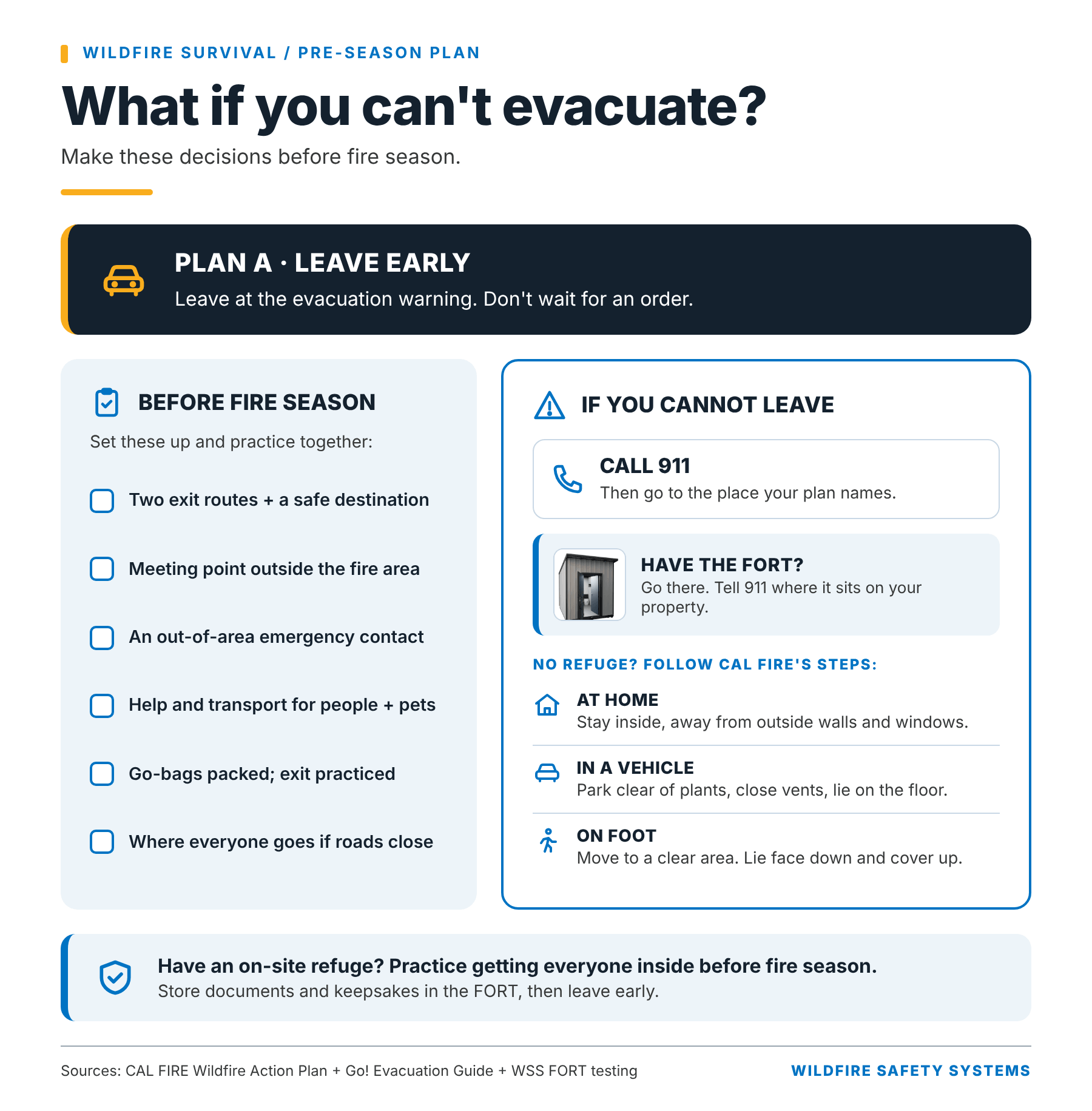
Turn this into a full household plan with CAL FIRE's Wildfire Action Plan.
If you have an on-site refuge like the FORT
An on-site refuge is the first place your plan sends everyone when fire closes the roads. If escape is not possible, the FORT is there. It has an engineered air supply, heat-resistant construction and a sealed interior to limit smoke. Its air system kept safe oxygen and carbon dioxide levels for up to 8 occupants over four hours in WSS's published testing.
If the roads close and you have the FORT:
- Call 911 and tell the dispatcher where the FORT sits on your property.
- Bring everyone in the household to the FORT.
- Follow the operating steps in how to use the FORT.
Practice getting the whole household inside before fire season, the same way you drill the drive out. If you don't have a refuge, CAL FIRE's at-home steps below are written for the house.
If you're trapped at home
CAL FIRE's Go! Evacuation Guide lists these steps for being trapped at home:
- Stay calm.
- Gather your family.
- Use your cell phone to call 911.
- Fill sinks and tubs with cold water.
- Keep doors and windows closed but unlocked.
- Stay inside, away from outside walls and windows.
If officials have issued a shelter-in-place instruction for your area, follow what that instruction says.
If you're trapped in a vehicle
CAL FIRE's steps for a vehicle:
- Stay calm.
- Park in an area clear of vegetation.
- Close all vehicle windows and vents.
- Cover up with a wool blanket or jacket.
- Lie on the vehicle floor.
- Use your cell phone to call 911.
A wool blanket kept in each car during fire season covers the fourth step.
If you're trapped on foot
CAL FIRE's steps on foot:
- Stay calm.
- Move to a clear area, like a ditch or flat ground.
- Lie face down and cover your body.
- Use your cell phone to call 911.
Readers comparing on-site options can see our guide to how a home fire shelter fits with evacuation plans.
After a Wildfire: How to Return Home Safely and Get Help
Go home only after officials say it's safe, and treat your property as a hazard zone on the first visit. CAL FIRE's guidance is short: don't return until fire officials tell you it's safe, and watch for downed power lines.
Stay away from hot ash, charred trees, smoldering debris and live embers. The ground can hide heat pockets that burn you or start another fire, according to the American Red Cross. Before you go inside, Cal OES says to check for the smell of gas and for embers in gutters, on the roof, under decks and in crawl spaces. Keep propane and natural gas valves closed until your supplier or utility inspects the system. Use flashlights until you know there's no electrical damage. Don't drink tap water until officials say it's safe. Photograph damage before you move anything, because your insurer will want to see it.
Recovery also takes a toll on people. The Disaster Distress Helpline, run by SAMHSA, offers free crisis counseling for people affected by disasters at 1-800-985-5990. Our guide to protecting valuables, records and people covers the documents and records that speed up a claim. The full re-entry guide covers utilities, cleanup room by room, insurance and assistance.
Returning Home After a Wildfire
How to Prepare Kids and Families to Survive a Wildfire
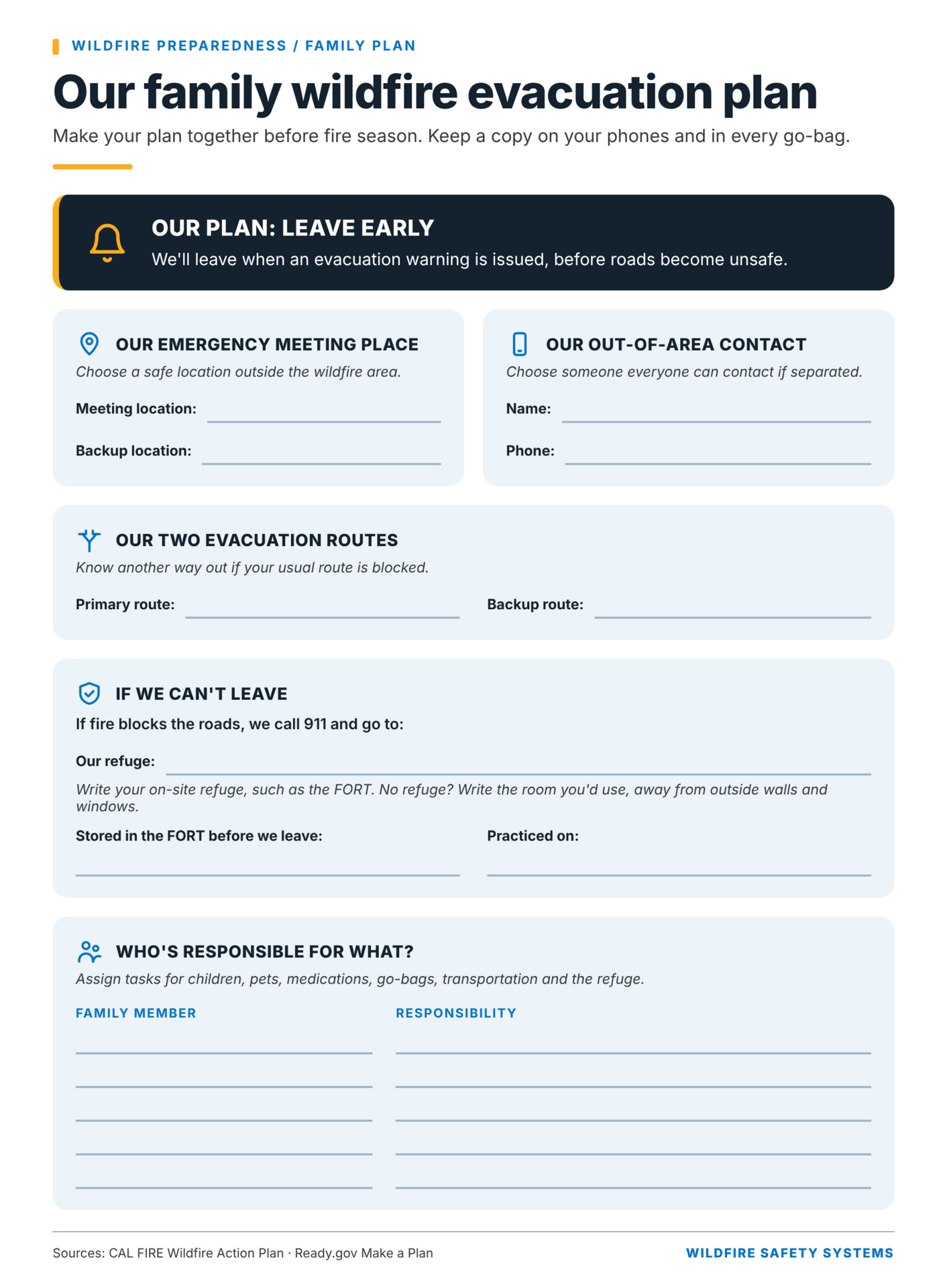
Kids handle a wildfire evacuation best when they've practiced it, know their job and know where the family will meet. Fill in the plan card below together in spring, keep a copy in each go-bag, and practice it before fire season.
Teach kids a few plain rules
Short, concrete rules are easier for kids to remember under stress. These come from Ready.gov's wildfire page for kids, plus the family plan:
- When officials say leave, we leave right away.
- Call 911 if you see a fire.
- If the roads are blocked, we call 911 and go to the FORT together.
- Your job is the dog's leash (or your own backpack, or helping your little brother).
- We meet at Grandma's house if we get separated.
- We don't go home until officials say it's safe.
- Grown-ups do the cleanup.
Practice an evacuation drill twice a year
Run the drill once before fire season and once in the middle of it. Time it from the first call to the car doors closing, and include the pets. Each drill turns up something the plan missed, like a cat that hides or a go-bag that's too heavy for a 7-year-old.
Ask your school about its plan
Schools in wildfire areas have their own evacuation sites and pickup rules, and they vary by district. Ask your school where students go if campus evacuates and who is allowed to pick them up. Give the school your out-of-area contact, the friend or relative everyone texts when local phone lines are jammed.
Plan for anyone who needs extra time
Older relatives, family members with mobility needs, anyone on medications that need refrigeration, and households with horses or other livestock all need more time to leave. Cal OES's definition of an evacuation warning tells these households to leave at the warning. CAL FIRE's evacuation guide also says to arrange livestock transport with neighbors or a hauler in advance if you don't own a trailer.
Where the FORT Fits in a Layered Wildfire Survival Plan
Evacuation is always the safest choice, and leaving early is the safest way to survive a wildfire. Every step in this guide is designed to make that departure faster. Fast-moving fires can still close roads before a household gets out.
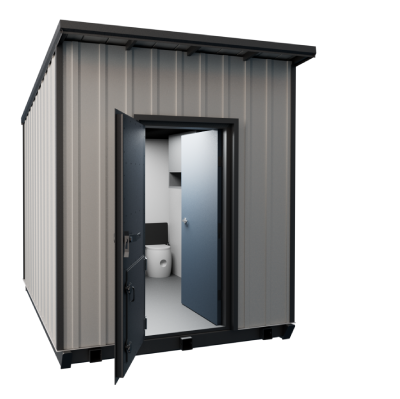
The FORT is an above-ground, on-site refuge designed to work alongside evacuation planning and home hardening, for the moment when leaving isn't possible. It has a managed air supply, heat-resistant construction and a sealed interior to limit smoke. In WSS's published testing, its materials were exposed to sustained temperatures up to 2,000°F, and its air system kept safe oxygen and carbon dioxide levels for up to 8 occupants over four hours.
The FORT also gives you a secure place for what you can't replace. Family documents, photo albums, heirlooms and backup drives can go inside before you leave, and they stay protected even if the house burns. With those items already secured, there's one less thing to sort out on the way out the door.
To see how the FORT works day to day, read how to use the FORT or configure one for your property.
Frequently Asked Questions
The safest way to survive a wildfire is to leave early, at the evacuation warning or sooner, before fire or smoke reaches your roads. CAL FIRE's Go! Evacuation Guide says it's safer to leave before a mandatory order is issued. Pack go-bags before fire season and agree as a family on when you'll go. Our fire evacuation checklist covers what to take and where to go.
If you're trapped in your house during a wildfire, call 911, then go to the place your family plan names: an on-site refuge like the FORT if you have one, or a room inside the house away from outside walls and windows. With the FORT, bring everyone there and tell the dispatcher where it sits on your property. Without a refuge, follow the at-home steps in CAL FIRE's Go! Evacuation Guide: gather your family, fill sinks and tubs with cold water, keep doors and windows closed but unlocked, and stay inside. If officials issue a shelter-in-place instruction for your area, follow that instruction.
To stay safe in a car during a wildfire, park in an area clear of vegetation, close every window and vent, cover up with a wool blanket or jacket, lie on the floor and call 911. These steps come from CAL FIRE's guidance for people trapped in a vehicle. Leaving at the evacuation warning is the best way to avoid driving near a fire at all. Our fire evacuation checklist helps you get on the road early.
You teach kids about wildfire safety by giving each child one job, a meeting place and a few plain rules, then practicing an evacuation drill twice a year. Good rules for kids: leave right away when officials say so, call 911 if you see a fire, and wait for officials before going home. If your family has an on-site refuge like the FORT, add one more: if the roads are blocked, we go there together. Ready.gov's wildfire page for kids explains these in kid-friendly language.
A home wildfire shelter built and tested for wildfire conditions can provide protection when evacuation isn't possible, as one layer of a plan that still puts leaving early first. The FORT is an above-ground, on-site refuge with a managed air supply that kept safe oxygen and carbon dioxide levels for up to 8 occupants over four hours in WSS's published testing. It's designed to work alongside home hardening, defensible space and an evacuation plan.
Key Takeaways
- Leave at the evacuation warning, and earlier if your household needs extra time.
- Embers cause up to 90% of home ignitions, so clear roofs, gutters and the ground next to the house first.
- Register every phone in the house for county alerts before fire season.
- If fire blocks the roads, call 911 and go to the FORT if you have one, or follow CAL FIRE's trapped steps.
- Give every child one job and one meeting place, and drill it twice a year.
- Go home only when officials say it's safe, and photograph damage before you move anything.
Final Thoughts
The decisions that get a family out fast are made long before the fire: when to leave, which road to take, who grabs the dog and where everyone meets. Make them in spring, write them down and practice them once. When the warning comes, the plan does the deciding. For homeowners building a layered plan, the FORT adds an on-site refuge for the moment when leaving isn't possible, and our wildfire preparedness resources cover the rest of the plan.